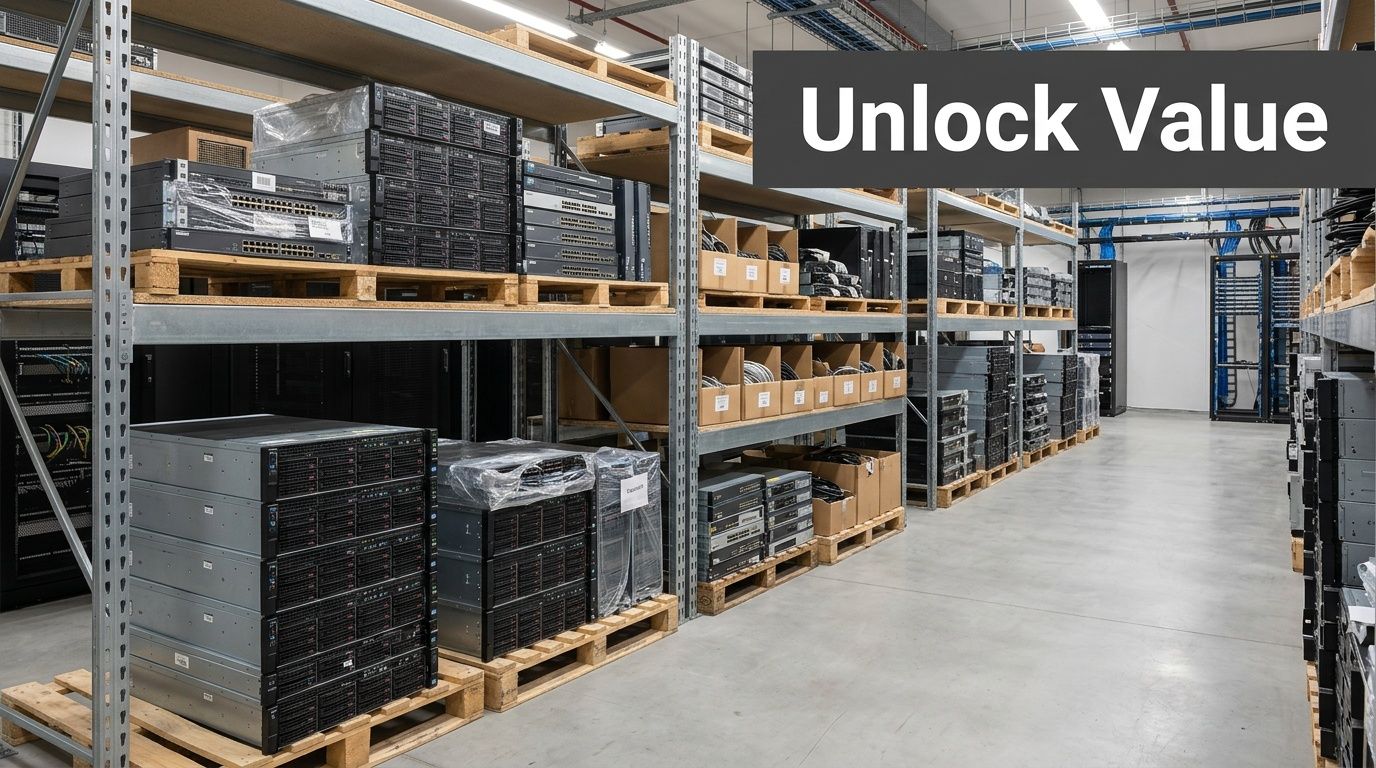
A lot of telecom equipment resale projects start the same way. A switch stack comes out during a refresh. A few routers get pulled after a carrier change. Optics, line cards, and spares land in a cage because nobody wants to dispose of something that might still be useful.
Months later, that “temporary” holding area turns into a balance-sheet blind spot. The gear isn’t supporting production, but it’s still consuming space, handling time, and attention. For IT directors, that’s the key trigger to treat retired telecom hardware as an asset recovery project instead of a cleanup task.
From Storeroom Cost to Strategic Asset
Decommissioned telecom gear has a habit of disappearing into operational gray space. It’s not active infrastructure, but it hasn’t reached formal disposition either. That’s where value leaks out.
The financial problem isn’t limited to shelving or warehouse rent. Legacy equipment keeps dragging behind it a chain of costs: depreciation, environmental controls, security exposure, audit uncertainty, and the lost opportunity to use that floor space for something productive. A documented case described by ROC Telecom’s analysis of hoarding old IT equipment found that a data center’s electricity costs to maintain unused gear exceeded the equipment’s resale value. After strategic decommissioning and resale, the facility cut utility expense and opened space for a new revenue-generating client.
What inaction actually costs
When organizations delay disposition, three things usually happen at once.
- Market value drops: Telecom hardware loses buyer interest as newer generations displace older models.
- Internal visibility gets worse: Asset tags go missing, accessories get separated, and nobody remembers which unit was working when removed.
- Risk expands: Gear may still hold configuration data, provisioning history, or removable media that should never sit unmanaged.
Practical rule: If a device has been off-network long enough that your team has to “figure out what it is” before selling it, you’ve already reduced recoverable value.
What works in real environments
The companies that recover the most from telecom equipment resale don’t start with the buyer. They start with policy. They decide that every network refresh, site closure, carrier migration, or data center change will trigger a disposition workflow.
That means retired routers, switches, transport gear, and telecom servers don’t go into limbo. They go into a controlled stream with ownership, documentation, and a disposition deadline.
What doesn’t work is the common fallback approach. Store it first, sort it later, sell it someday. That approach creates mixed pallets, incomplete kits, and internal disagreement over what can be reused versus sold.
A better view is simple. Your storeroom is either preserving value or destroying it. Most organizations know which one is happening.
Preparing for Resale Secure Data Destruction and Auditing
The highest resale values usually come from the best-prepared lots. Buyers pay for confidence. They discount uncertainty.
That’s why prep work matters more than most IT teams expect. CXtec’s guidance on used networking equipment notes that success in the secondary market starts with thorough asset documentation and condition assessment, because undisclosed flaws create testing delays and reduce proceeds.
Audit first, not later
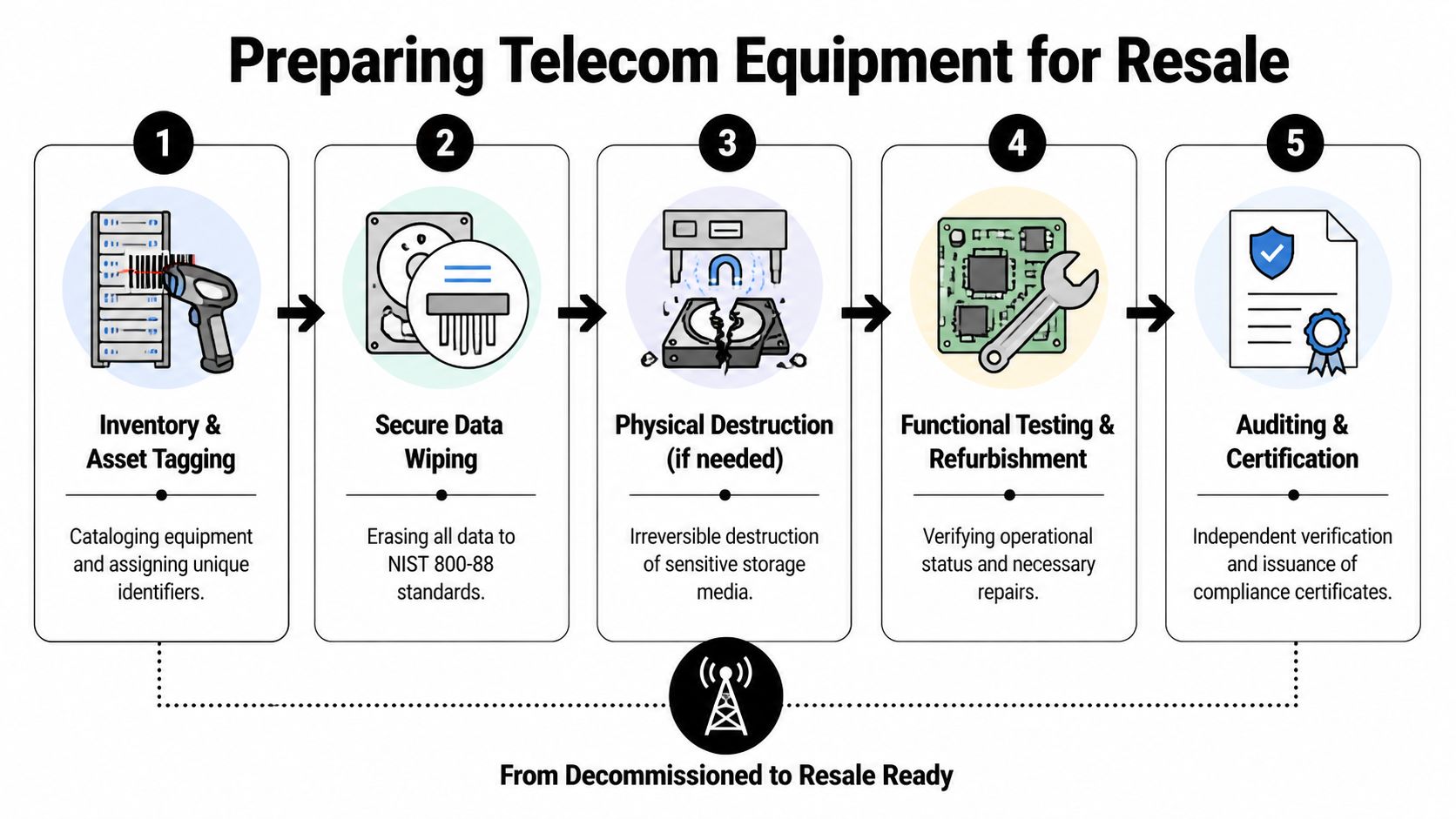
Start with a structured inventory. For each asset, capture:
- Exact identity: Manufacturer, model, serial number, asset tag, and installed modules.
- Functional status: Working pull, untested, failed, damaged, or incomplete.
- Commercial completeness: Power supplies, fan trays, faceplates, rail kits, cards, transceivers, and cables that materially affect resale.
Mixed-condition telecom lots are where payout disputes begin. If your internal list says “Cisco switches” and the buyer receives chassis with missing blanks, failed ports, or no power supplies, the final settlement will move against you.
The audit should reflect what will arrive on the dock, not what the team assumes is in the pallet.
Match data destruction to the device
Telecom equipment often contains more than obvious storage. Core appliances, management modules, voice systems, and certain network platforms can retain configurations, credentials, call records, provisioning information, and customer or enterprise metadata.
Use a destruction method that fits the actual media and your risk policy:
- Software wiping works when the media is reusable and your policy allows sanitization. For teams aligning with recognized sanitization practices, Beyond Surplus provides guidance on NIST SP 800-88 data wiping standards.
- Degaussing fits magnetic media where reuse is not the priority and irreversible neutralization is required.
- Physical destruction is the cleanest option for failed drives, highly sensitive media, or regulated environments that don’t want residual doubt.
Some organizations also pair telecom equipment removal with broader office shutdown projects. If your refresh includes furniture, fixtures, and floor reconfiguration, it helps to streamline your office furniture removal on the same project timeline so the site closes cleanly.
Refurbishment decisions that help payout
Not every piece of gear deserves repair. Testing should separate:
- units worth refurbishing for resale
- units better sold as-is
- units that belong in parts harvesting or recycling
The mistake is applying the same workflow to all equipment. A current, in-demand switch with cosmetic wear may deserve bench testing and light refurbishment. A significantly outdated platform with missing modules may be better processed quickly with no added labor.
The practical goal isn’t perfection. It’s documented condition, secure sanitization, and a lot structure that a buyer can price without guesswork.
Decoding Value and Navigating Pricing Models
IT directors usually know when equipment has value. The hard part is determining whether an offer reflects that value fairly.
That’s where telecom equipment resale gets opaque. Tempest’s telecom buyback discussion highlights a real gap in the market: mixed-condition inventory is hard to benchmark, and some retired analog equipment may sell for 10% or less of its original cost. The problem isn’t only low value. It’s the lack of a standard framework for understanding how a buyer reached the number.

What actually drives telecom resale value
Buyers typically look at five value levers.
| Factor | Why it matters |
|---|---|
| Platform relevance | Gear tied to current network needs draws more interest than retired architectures. |
| Condition | Clean working pulls price better than damaged or incomplete units. |
| Configuration | Memory, supervisors, optics, licenses, and cards change marketability. |
| Quantity | Larger, consistent lots are easier to place than random singles. |
| Documentation quality | Good manifests reduce buyer risk and improve quoting confidence. |
A useful mental model comes from broader discussions of value based pricing for B2B. In resale, buyers aren’t pricing what you paid. They’re pricing what they can confidently test, place, support, and move.
The three common offer structures
Not every offer means the same thing.
- Outright cash buyback: Fastest and simplest. You transfer the equipment and get paid based on the agreed schedule and final audit.
- Consignment: Higher upside is possible, but settlement takes longer and depends on actual downstream sale activity.
- Credit arrangement: Useful during refresh cycles if the credit offsets upcoming purchases or services you already need.
If the offer structure is clear but the valuation logic is vague, you still don’t have transparency.
Questions to ask before accepting any bid
Ask for answers at the asset level, not just the lot level.
- How are working, non-working, and incomplete units separated in the quote?
- Which components are priced individually, and which are bundled into a blended rate?
- What happens if cosmetic damage, missing accessories, or failed ports appear during testing?
- Is freight included, deducted later, or conditional on minimum recovery?
- Will the buyer provide itemized reporting after receipt?
For teams that want a direct market outlet, telecom equipment buyers should be evaluated on reporting discipline as much as top-line numbers.
What usually fails in practice is accepting a single blended offer for a heterogeneous lot. That makes comparison nearly impossible. The safer move is to force transparency early, even if that slows the first quote.
Choosing Your Sales Channel and Managing Logistics
There isn’t one correct sales channel for telecom equipment resale. There’s only the channel that fits your priorities.
That distinction matters because the U.S. reseller environment is crowded. According to Viirtue’s 2025 telecom reseller market overview, the U.S. telecommunications-reseller industry is projected to reach USD 23.4 billion in 2025, with 2,536 establishments competing in the market. More options can help sellers. They also create noise.
Comparing the main channels
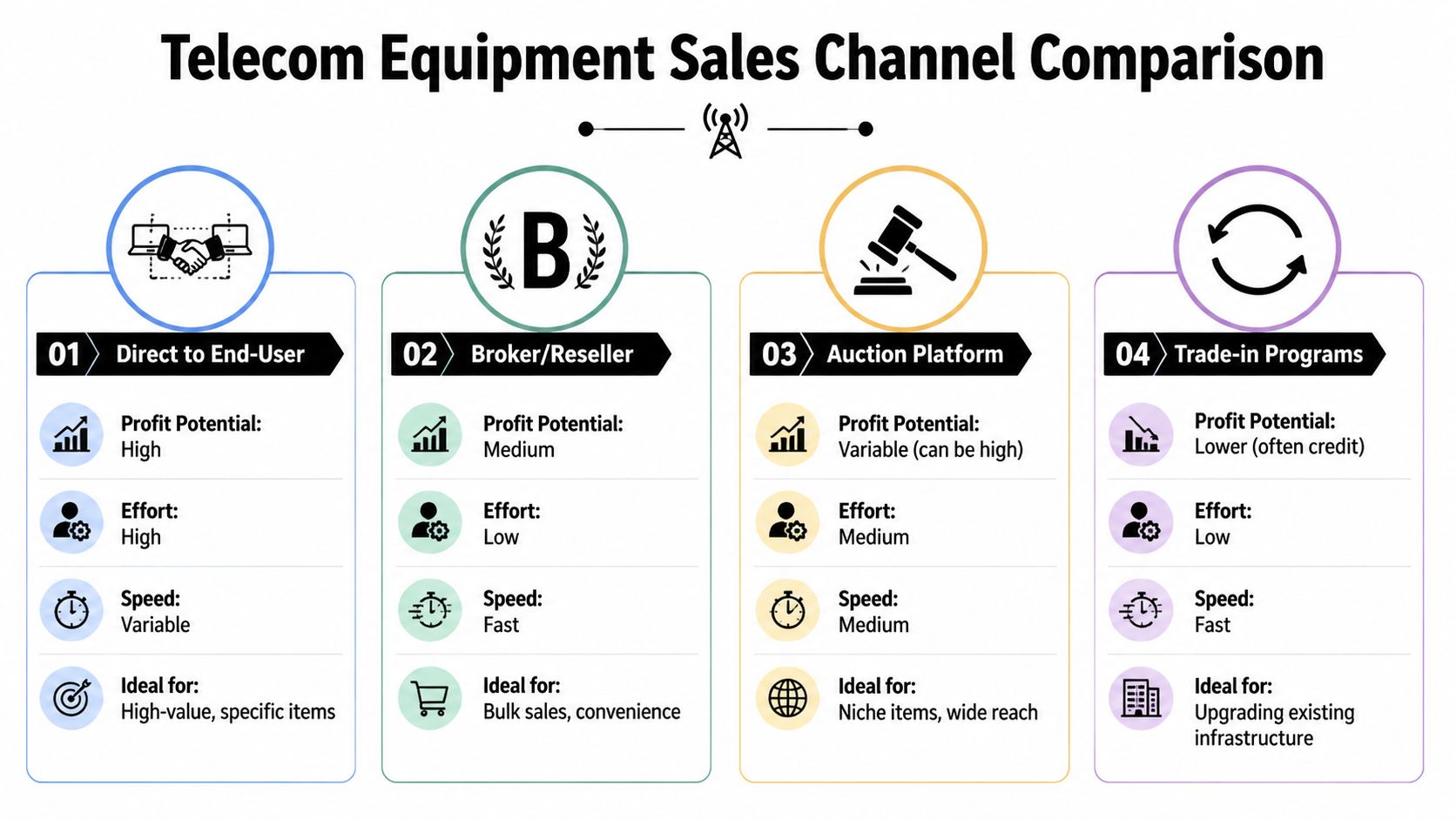
| Channel | Best fit | Main upside | Main trade-off |
|---|---|---|---|
| Direct to end user | Specific high-demand items | Strong recovery potential | Heavy internal effort |
| Broker or reseller | Mixed lots and bulk disposition | Speed and convenience | Lower control over end placement |
| Auction platform | Niche or broad-interest inventory | Wider buyer exposure | Variable outcomes |
| Trade-in program | Planned infrastructure refresh | Simpler transaction | Often lower flexibility |
Direct sale works when your team knows exactly what it has and can wait for the right buyer. Auction can work when the market is uncertain and demand discovery matters. Trade-in is efficient when procurement timing drives the project.
For most enterprise lots, a broker or ITAD-led resale path wins because it reduces effort and centralizes logistics.
Logistics is where projects break down
A surprising number of otherwise solid resale projects lose money after the quote is signed.
Common failure points include:
- Poor palletization: Chassis shift in transit, bezels crack, and parts go missing.
- Loose accessories: Power cords, rails, and optics get separated from the parent asset.
- Weak chain of custody: Nobody can show where equipment was from pickup to receipt.
- Uninsured or mismatched freight: Claims get messy when the shipment method doesn’t fit the load.
For larger regional or multi-site projects, a dedicated reverse logistics service in Atlanta can help centralize pickup, staging, and documented transportation before final resale or recycling.
Secure logistics isn’t an add-on to value recovery. It’s one of the controls that protects value from the loading dock forward.
Match the channel to the workload
If your team wants maximum return and can tolerate more internal labor, direct sale may fit. If your priority is site speed, reporting, and controlled handling, a managed channel usually performs better.
The wrong choice is trying to maximize every variable at once. High recovery, low effort, fast turnaround, and minimal risk rarely arrive together.
Ensuring Compliance and Documenting Liability Transfer
For regulated organizations, telecom equipment resale is never just a financial event. It’s a records event, a security event, and often a legal event.
That’s especially true for telecom-specific hardware. CES Telecom’s industry perspective highlights a compliance gap that generic ITAD processes often miss. Telecom equipment can carry regulatory metadata and network integration history that require audit trails and clear documentation of responsibility transfer throughout disposition.

Generic ITAD controls are not always enough
A standard desktop disposal workflow may focus on drives, serials, and recycling downstreams. Telecom hardware often needs more.
Think about what can remain attached to the equipment record or embedded in the system lifecycle:
- Provisioning history
- Carrier or network configuration context
- Enterprise routing and authentication settings
- Audit evidence tied to prior operation
- Media or modules removed separately from the chassis
In healthcare, finance, government, and other controlled environments, missing documentation creates a significant problem. If a regulator, auditor, client, or internal security team asks what happened to a specific retired appliance, “it was sent out for recycling” isn’t enough.
Documentation that should be non-negotiable
A serious telecom disposition file should include:
- Pickup and chain-of-custody records showing who released the assets, when, and in what quantity.
- Asset-level inventory reporting tied to serial numbers and disposition method.
- Data destruction evidence for any storage-bearing or configuration-retentive media.
- Recycling or downstream documentation for assets that were not resold.
- Formal liability transfer language where the service provider assumes responsibility within the defined scope.
For destruction events, certificate of destruction documentation matters because it creates a formal record that supports internal audit and external review.
Compliance failures in telecom resale usually don’t begin with bad intent. They begin with incomplete paperwork around otherwise routine removals.
The practical compliance stance
Treat telecom resale the same way you treat a controlled data movement. Assign ownership. Define approved methods. Preserve records. Require evidence.
That discipline also helps the commercial side. Buyers and processors work faster when the asset history is organized and the release path is clear. Compliance and value recovery aren’t competing goals here. In well-run projects, they reinforce each other.
Selecting the Right ITAD Partner for Telecom Assets
The partner selection process should be tougher for telecom gear than for commodity laptops or office PCs. The hardware is more specialized, the compliance issues are narrower, and the resale outcomes vary more by handling quality.
Start with diligence, not with the quote sheet. A low-friction offer can still produce poor reporting, soft chain-of-custody controls, or aggressive settlement adjustments after receipt.
The vendor checklist that matters
Use a checklist that tests operational maturity.
- Data security capability: Can the provider support sanitization, destruction, and documented handling for storage-bearing or configuration-retentive devices?
- Telecom testing knowledge: Can they evaluate switches, routers, optics, voice gear, and related modules accurately?
- Asset-level reporting: Do they report by serial and condition, or only by pallet and weight?
- Logistics reach: Can they coordinate pickup, staging, and freight across multiple facilities?
- Insurance and liability posture: Are they prepared to document responsibility clearly?
- Environmental downstream controls: Can they show what happens to non-resalable material?
For formal procurement review, a vendor due diligence checklist helps structure the questions that often get skipped during fast-moving decommission projects.
What strong partners do differently
Strong providers don’t rely on vague category pricing. They ask better intake questions, challenge incomplete inventories, and separate resale, parts harvest, destruction, and recycling streams early.
This is also where one managed option can simplify execution. Beyond Surplus handles IT asset disposition, secure data destruction, logistics coordination, and telecom equipment buyback as part of a single enterprise workflow, which can reduce handoff risk for organizations managing mixed lots.
What doesn’t work is splitting responsibility across too many vendors without one controlling the chain of custody. One company packs the gear, another shreds drives, a third buys the hardware, and no one owns the complete record. That arrangement creates audit gaps and payout disputes.
A telecom resale partner should function like an extension of your operations team. If they can’t explain how they protect value and document risk transfer, keep looking.
Conclusion Your Next Step in Asset Value Recovery
Telecom equipment resale works best when it’s treated as a disciplined asset recovery process. The value comes from timing, documentation, secure data handling, channel selection, and compliance control. Skip any one of those, and the economics shift fast.
The broader market supports the opportunity. The global telecom equipment market projection from GM Insights says the sector is projected to grow at a 7.5% CAGR from 2025 to 2034, reaching approximately USD 603 billion. Those refresh cycles continue feeding the secondary market for organizations that manage retired assets strategically.
Don’t let decommissioned gear sit until its condition, audit trail, and market value all get worse. Build a repeatable process, require transparency from buyers, and document every transfer point from rack removal to final disposition.
Contact Beyond Surplus for a complimentary assessment of your telecom equipment and a certified plan for secure, profitable IT asset disposal.