Choosing an IT Asset Disposition (ITAD) and electronics recycling vendor is a critical business decision with major security, financial, and environmental consequences. A poorly selected partner can expose your organization to data breaches, regulatory fines, and brand damage. To avoid these risks, a formal evaluation process is vital. This vendor due diligence checklist offers a structured framework for businesses to thoroughly examine potential ITAD partners. The goal is to ensure they meet the highest standards of security, compliance, and operational performance.
Following this guide will help your organization make a well-informed and defensible choice. Each step, from verifying data destruction certifications and confirming insurance coverage to assessing environmental practices, is designed to provide clarity and reduce risk. The items covered in this article include:
- Data Security and Certification Standards Verification
- Financial Stability and Insurance Coverage
- Environmental Compliance and Sustainability Practices
- Operational Capacity and Service Coverage
- Asset Valuation and IT Buyback Capabilities
- Chain of Custody and Documentation Standards
- Regulatory Compliance and Industry-Specific Requirements
- Vendor Background Screening and Reference Verification
This definitive checklist empowers IT managers, procurement professionals, and business owners to confidently select a dependable partner. The right vendor does more than just dispose of old equipment; they protect your data, safeguard your reputation, and work to maximize the financial return on your retired assets. A thorough vendor due diligence checklist is the first step in building a secure and responsible ITAD program.
1. Data Security and Certification Standards Verification
The cornerstone of any responsible IT asset disposition (ITAD) partnership is a non-negotiable commitment to data security. Before entrusting a vendor with retired assets containing sensitive information, your vendor due diligence checklist must start with verifying their data destruction and security certifications. These standards are not just badges; they represent a documented, audited, and repeatable process for permanently eradicating data in line with government and industry best practices.

Reputable vendors validate their processes through certifications such as NIST SP 800-88, the gold standard for media sanitization, or ISO/IEC 27001, which covers a broader information security management system. For organizations in regulated fields like healthcare or finance, this verification is critical for demonstrating compliance with HIPAA or GLBA, effectively transferring liability and mitigating breach risks.
Actionable Verification Steps
To properly vet a potential partner, move beyond simply asking if they are certified. Take these concrete steps:
- Request and Review Certificates: Ask for a copy of their actual certification documents for NIST SP 800-88 compliance, ISO 27001, or others. Check the issue date and expiration date to ensure they are current.
- Verify the Scope: Confirm that the certification covers all data destruction methods they offer, including software-based wiping, degaussing (for magnetic media), and physical shredding. A certification for wiping alone is insufficient if you require hard drive shredding.
- Examine Proof of Destruction: A key deliverable is the certificate of data destruction, which serves as your audit trail. Request a sample to ensure it includes essential details like asset serial numbers, the destruction method used, and the date of service. A robust destruction certificate template will show you what to look for in a legally defensible document that transfers liability.
- Confirm Insurance Coverage: A certified process should be backed by adequate insurance. Inquire about their cyber liability and errors and omissions insurance policies to understand your financial protection in a worst-case scenario.
2. Financial Stability and Insurance Coverage
An ITAD vendor's operational excellence is meaningless if they are not financially stable or adequately insured. A crucial part of your vendor due diligence checklist involves assessing their financial health and verifying their insurance coverage. A vendor on shaky financial ground may cut corners on security or environmental compliance, while insufficient insurance leaves your organization exposed to significant financial and reputational damage in the event of a data breach, accident, or service failure.
Verifying financial solvency ensures the vendor can fulfill long-term service agreements and has the resources to maintain high standards. Likewise, robust insurance, including general liability, errors and omissions, and cyber liability, provides a critical safety net. For instance, many Fortune 500 companies mandate that their ITAD partners carry liability insurance in the range of $2-5 million to mitigate risk, a standard met by established vendors. This step protects your organization from shouldering the costs of a potential mishap.
Actionable Verification Steps
Go beyond a simple "yes" when asking about their financial and insurance status. Dig deeper with these specific actions:
- Request a Certificate of Insurance (COI): Before any engagement, ask for their current COI. This document officially details their coverage types, policy limits, and the insurance carrier. Check that the policy dates are valid.
- Verify Coverage Amounts: Confirm that their general liability, cyber liability, and errors and omissions policy limits meet your organization's risk tolerance. Ensure the cyber liability policy specifically covers costs related to data breach notifications, credit monitoring, and regulatory fines.
- Assess Financial Health: For larger contracts, consider requesting key financial statements to gauge their stability. A fundamental grasp of understanding financial statements is essential for this part of the due diligence process, as it helps you evaluate their long-term viability.
- Confirm Continuous Coverage: A single COI is a snapshot in time. For ongoing partnerships, contractually require the vendor to provide annual proof of continuous coverage to ensure there are no lapses that could expose your business.
3. Environmental Compliance and Sustainability Practices
Beyond data security, a critical part of your vendor due diligence checklist must address how a partner manages the environmental impact of retired IT assets. Improper disposal of e-waste can lead to significant environmental contamination and legal penalties. Partnering with a vendor committed to responsible recycling ensures your organization avoids these liabilities and upholds its corporate sustainability goals.
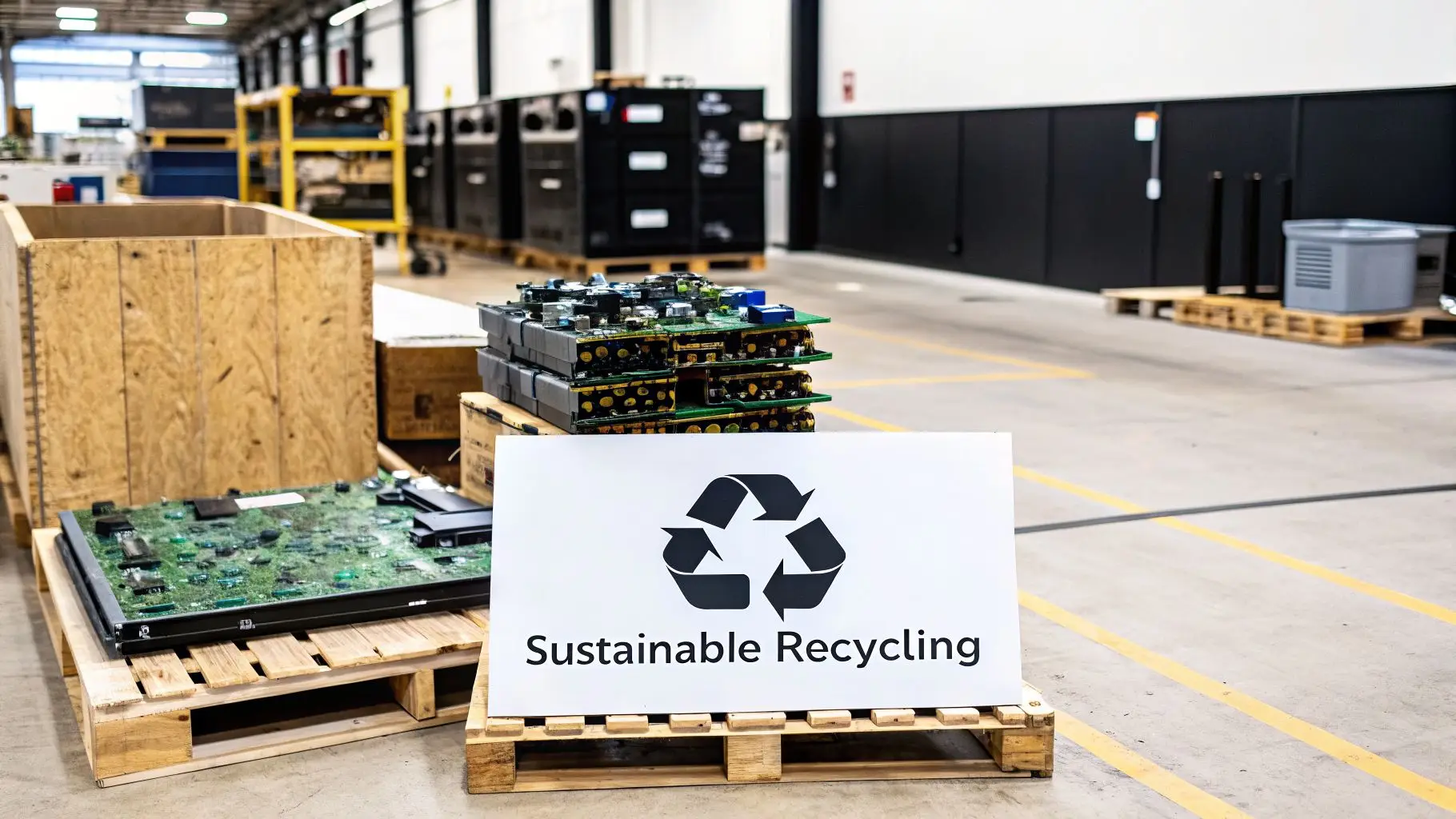
Reputable ITAD vendors demonstrate their commitment through globally recognized certifications like R2 (Responsible Recycling) and e-Stewards. These standards mandate safe and ethical handling of hazardous materials, prevent the illegal export of e-waste, and promote a circular economy. Major tech companies like Microsoft and IBM require their ITAD partners to hold these certifications, ensuring their supply chains adhere to strict environmental protocols and support their ESG (Environmental, Social, and Governance) objectives.
Actionable Verification Steps
Verifying a vendor's environmental claims requires more than accepting a logo on their website. Dig deeper with these concrete actions:
- Request and Validate Certifications: Ask for copies of their current R2 or e-Stewards certificates. Verify the issue and expiration dates on the official certification body's website to confirm they are active and legitimate.
- Investigate Downstream Partners: No single recycler processes all materials. Ask for a list of their downstream vendors who handle specific commodities like circuit boards, batteries, and plastics. Confirm that these partners also hold relevant certifications.
- Analyze Environmental Reports: Request documentation that shows their material recovery and landfill diversion rates. A credible partner should be able to provide reports detailing how much material was recycled, reused, or disposed of, proving their commitment to minimizing waste. This is a core part of how ESG principles are applied to electronics recycling in practice.
- Inquire About Material Destinations: Ask where recycled materials are sent. A transparent vendor can explain their process for recovering precious metals, sending plastics to manufacturers, and responsibly managing hazardous elements, giving you a clear picture of their circular economy model.
4. Operational Capacity and Service Coverage
A vendor's certifications and security protocols are meaningless if they lack the operational infrastructure to handle your specific needs. Evaluating a potential partner's capacity is a critical part of your vendor due diligence checklist, ensuring they can manage your asset volume, geographic footprint, and required service timelines without compromising security or efficiency. This step confirms the vendor can scale with your organization, whether you're a single-site business or a multi-state enterprise.
Scalability is a key differentiator. A vendor with a national footprint can execute complex, multi-site data center de-installations across the country, while regional specialists offer focused pickup services with the logistics network to coordinate nationwide projects for larger clients. Your goal is to find a partner whose logistical capabilities align perfectly with your operational reality, preventing delays and ensuring a consistent service standard across all locations.
Actionable Verification Steps
To accurately gauge a vendor's operational muscle, you need to dig deeper than their marketing materials. Use these practical verification steps:
- Review Geographic Coverage: Don't just take their word for it. Request detailed service area maps or a list of states and cities they directly service versus those covered by partners. If you have locations in multiple states, confirm they can provide a unified service level.
- Assess Fleet and Facility Capacity: Ask about the size of their truck fleet and the square footage of their processing facilities. This gives you a tangible measure of their ability to handle large pickups and process high volumes of assets, especially during peak disposal periods.
- Confirm Scheduling and Response Times: Inquire about their standard lead time for scheduling a pickup. For urgent needs, what is their guaranteed response time? This is vital for projects with tight deadlines, like office moves or data center closures.
- Discuss Volume and Asset Specifics: Be transparent about your expected disposal volume and the types of assets you have (e.g., servers, laptops, specialized medical equipment). Verify they have direct experience and the right equipment to handle your specific inventory.
- Request Relevant References: Ask for references from organizations of a similar size and with a comparable geographic distribution to your own. Speaking with a peer can provide invaluable, real-world insight into the vendor's performance and reliability.
5. Asset Valuation and IT Buyback Capabilities
An effective IT asset disposition strategy does more than just securely dispose of old equipment; it recovers residual value, turning a cost center into a potential revenue stream. A crucial part of your vendor due diligence checklist is assessing a potential partner's capabilities in asset valuation and IT buyback. This involves evaluating their expertise in identifying functional hardware, refurbishing it for resale, and offering fair market value, all while securely managing assets with no remaining value.
Top-tier vendors provide robust IT buyback services, transforming functional equipment into recovered capital. The right partner possesses the market knowledge and logistical infrastructure to accurately appraise your assets, maximize their resale value, and provide transparent financial returns, offsetting the costs of secure data destruction and recycling for non-salvageable items.
Actionable Verification Steps
To ensure you are maximizing financial recovery from your retired IT assets, go beyond a simple price quote. Take these specific verification steps:
- Request the Valuation Methodology: Ask potential vendors to outline their process for appraising equipment. Do they base it on model, configuration, cosmetic condition, and current market demand? A transparent methodology is a sign of a reputable partner.
- Obtain Pre-Service Estimates: Before committing your assets, request detailed appraisals or price estimates. Compare these offers across multiple vendors to gauge the market and ensure you are receiving a competitive price.
- Separate Asset Streams: Discuss how the vendor differentiates between functional equipment destined for resale and non-salvageable assets requiring destruction and recycling. This separation is key to maximizing value while ensuring compliance.
- Clarify Payment Terms and Reporting: Confirm the payment schedule (e.g., net 30, net 60, upon final sale) and the level of detail in their settlement reports. A good report will itemize each asset by serial number, its final disposition (resold or recycled), and the value recovered.
6. Chain of Custody and Documentation Standards
An unbroken chain of custody is the backbone of a secure and compliant IT asset disposition process. It creates a detailed, legally defensible audit trail that documents every movement and action taken on your assets, from the moment they leave your facility to their final destruction or recycling. Your vendor due diligence checklist must thoroughly scrutinize a partner’s ability to provide transparent, real-time tracking and comprehensive documentation. This isn’t just about logistics; it’s about maintaining accountability and mitigating risk at every step.
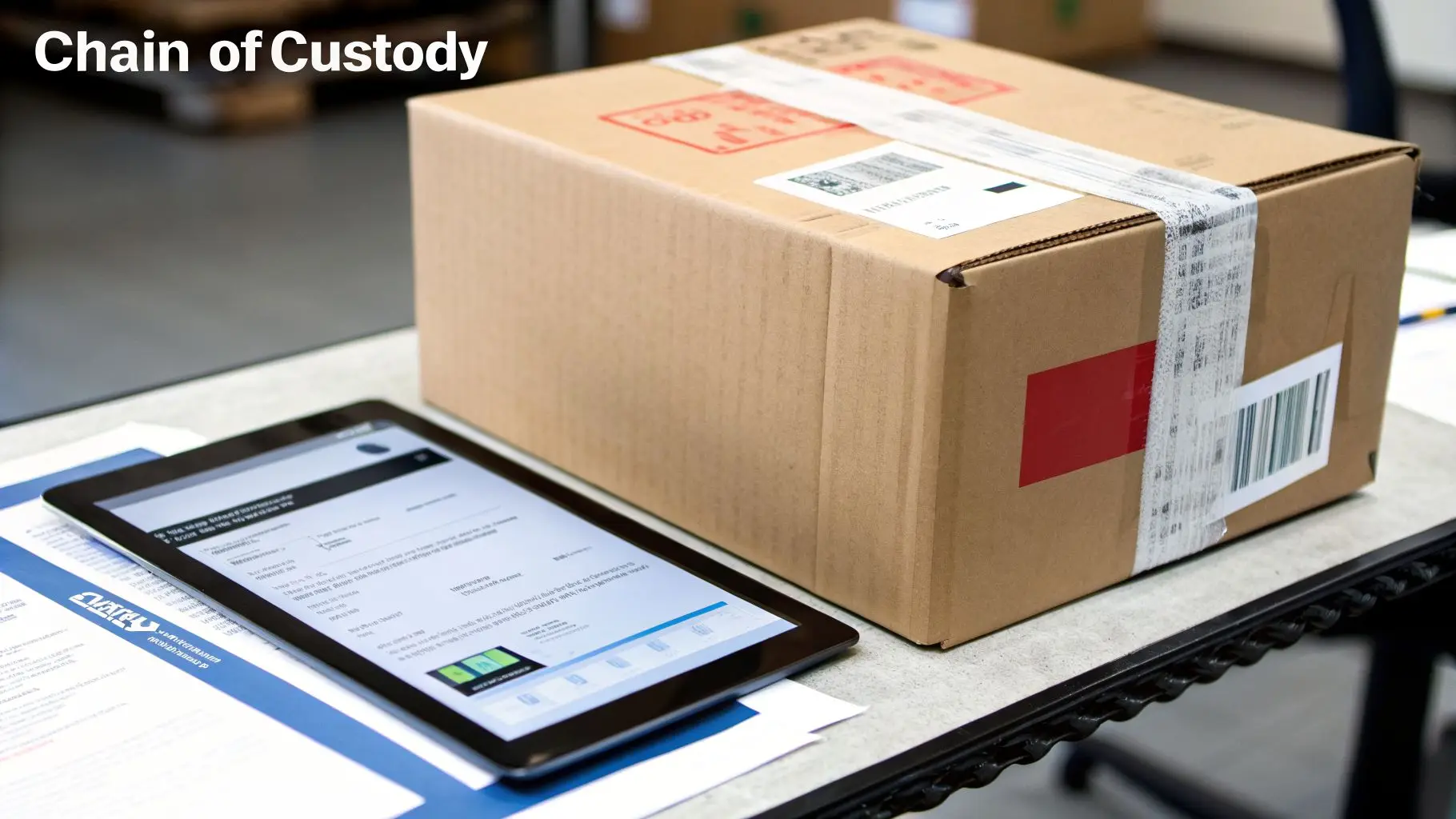
Leading vendors demonstrate this accountability through robust systems. For example, some government contracts require vendors to maintain DoD-compliant chain-of-custody records, while other secure ITAD providers use advanced asset tracking for immutable disposition verification. The goal is to eliminate blind spots. You should always know the status and location of your retired hardware, ensuring no asset goes unaccounted for, which is critical for preventing theft, data breaches, and compliance failures.
Actionable Verification Steps
To confirm a vendor's documentation and tracking capabilities are up to standard, go beyond a simple verbal confirmation. Take these specific actions:
- Request Sample Documentation: Ask for a complete set of their chain-of-custody documents, from the initial pickup receipt to the final report. This should include detailed asset lists, transfer forms, and certificates.
- Verify Asset Tracking Methods: Confirm that the vendor uses serialized barcode scanning at every touchpoint. This creates an electronic log detailing who handled the asset, when, and where. Inquire if they offer a client portal for real-time tracking access during processing.
- Examine the Final Certificates: The Certificate of Destruction or Recycling is your proof of compliance. Reviewing a detailed destruction certificate template ensures your vendor’s version is sufficient. Verify that their certificates include individual asset details like serial numbers, make, model, the specific service performed (e.g., wiped, shredded), and the date of completion.
- Ask About Incident Reporting: A mature process includes a plan for exceptions. Ask for their official procedure for reporting and investigating any assets that are lost, damaged, or cannot be accounted for during transit or processing. This reveals their level of preparedness and transparency.
7. Regulatory Compliance and Industry-Specific Requirements
Beyond general data security, a critical part of your vendor due diligence checklist is ensuring the ITAD provider meets the specific regulatory mandates governing your industry. Compliance is not optional; for sectors like healthcare, finance, or government, it's a legal requirement. A vendor's failure to adhere to regulations like HIPAA, GLBA, or PCI-DSS can expose your organization to severe penalties, reputational damage, and legal action. You need a partner who understands and has implemented controls specific to your regulatory environment.
For example, a healthcare provider must ensure its ITAD vendor signs a HIPAA Business Associate Agreement (BAA) and follows strict protocols for handling Protected Health Information (ePHI). Likewise, financial institutions must verify a vendor’s processes align with the Gramm-Leach-Bliley Act (GLBA) to protect consumer financial data. Choosing a vendor without this specialized knowledge is a significant risk.
Actionable Verification Steps
Go beyond a simple "yes" when asking about regulatory compliance. Dig deeper with these concrete actions:
- Request Compliance Documentation: Ask for copies of relevant compliance audit reports, attestations, or certifications. For government contractors handling Controlled Unclassified Information (CUI), this may mean verifying their alignment with NIST SP 800-171.
- Require Business Associate Agreements (BAAs): If you operate in healthcare, a signed BAA is non-negotiable. This legal contract outlines the vendor's responsibilities for protecting ePHI. Before engaging a vendor, it's wise to ensure they understand what HIPAA-compliant electronics recycling entails.
- Verify Chain of Custody and Transportation: Certain regulations extend to the physical transport of assets. For instance, ensuring your vendor's logistics team follows an essential DOT compliance checklist can be a key part of managing risk during transit.
- Review Breach Notification Procedures: Confirm the vendor's incident response and breach notification plan aligns with the strict timelines and requirements of your industry's regulations. Ask for their documented procedure to see how they would handle a potential incident involving your assets.
8. Vendor Background Screening and Reference Verification
While certifications confirm a vendor's processes on paper, a thorough background check and reference verification reveal their real-world performance and business integrity. This step in your vendor due diligence checklist moves beyond technical specifications to assess the vendor's reputation, financial stability, and historical reliability. It's a critical investigation that uncovers potential red flags, like litigation history or regulatory violations, that could expose your organization to operational or reputational risk.
Reputable partners welcome this scrutiny because it distinguishes them from less dependable operators. For instance, government agencies are often required to verify vendors through databases like SAM.gov, while financial institutions conduct deep dives into litigation records to ensure their partners meet stringent compliance standards. This process validates that the company you are engaging is not only capable but also trustworthy and stable.
Actionable Verification Steps
A proactive approach to background screening provides a complete picture of the vendor. Go beyond their provided marketing materials with these actions:
- Request and Independently Verify References: Ask for a list of 3-5 current clients, preferably from organizations of a similar size or in your industry. When possible, use professional networks like LinkedIn to find other contacts at those companies to get an unscripted perspective on service quality and responsiveness.
- Investigate Business and Legal History: Use public records to search for litigation history in state and federal courts. Check their business registration and licensing status with the Secretary of State. You can also consult services like Dun & Bradstreet for business credit and financial stability reports.
- Examine Service Quality Records: Ask references specific, pointed questions: "Can you describe a time a service issue occurred and how the vendor resolved it?" or "How accurate and timely is their reporting?" Review their Better Business Bureau (BBB) rating and any complaints filed.
- Assess Personnel Stability: Inquire about the tenure and experience of key personnel who would manage your account. High turnover in critical roles can be a sign of internal instability, which may impact service consistency and the quality of your IT asset disposition program.
8-Point Vendor Due Diligence Comparison
| Item | Implementation Complexity 🔄 | Resource Requirements ⚡ | Expected Outcomes 📊 | Ideal Use Cases 💡 | Key Advantages ⭐ |
|---|---|---|---|---|---|
| Data Security and Certification Standards Verification | High 🔄 — audits, certified processes required | Medium‑High ⚡ — certified vendors, audit fees, documentation | High 📊 — defensible data destruction and regulatory compliance | Regulated sectors (healthcare, finance, government) | Transfers liability; meets HIPAA/PCI‑DSS/SOX |
| Financial Stability and Insurance Coverage | Medium 🔄 — document & verify policies and statements | Medium ⚡ — COIs, financial reports, legal review time | High 📊 — financial recourse and vendor reliability | High‑value contracts; long‑term vendor relationships | Protects from vendor failure/breach; credibility proof |
| Environmental Compliance and Sustainability Practices | Medium‑High 🔄 — certifications and downstream audits | High ⚡ — certified facilities, eco‑processing, audits | High 📊 — reduced environmental liability; ESG reporting | Organizations with sustainability mandates; public procurement | Avoids fines; improves ESG and brand reputation |
| Operational Capacity and Service Coverage | Medium 🔄 — logistics coordination and scaling ops | High ⚡ — fleet, facilities, staff, scheduling systems | High 📊 — reliable multi‑site service and scalability | Distributed enterprises, data center de‑installs | Scalability; consolidated vendor management |
| Asset Valuation and IT Buyback Capabilities | Medium 🔄 — technical grading and market analysis | Medium ⚡ — refurbishment labs, sales channels, testing | Medium‑High 📊 — recovered value; lower net disposal cost | Firms seeking asset recovery and budget offsets | Recovers revenue; transparent valuation options |
| Chain of Custody and Documentation Standards | High 🔄 — robust tracking, digital recordkeeping | Medium‑High ⚡ — asset‑tracking tools, retention systems | High 📊 — auditable trail and legal defensibility | Audit‑heavy environments; legal holds; compliance audits | Accountability; simplifies audits and reconciliations |
| Regulatory Compliance and Industry‑Specific Requirements | High 🔄 — multiple certifications & ongoing attestations | High ⚡ — training, policies, regular assessments | High 📊 — regulatory adherence and reduced liability | Healthcare, finance, government contractors | Ensures mandatory compliance; audit‑ready evidence |
| Vendor Background Screening and Reference Verification | Medium 🔄 — research, checks, reference outreach | Medium ⚡ — time, third‑party reports, verification tools | Medium‑High 📊 — risk identification; vendor confidence | New vendors; high‑risk or strategic engagements | Uncovers red flags; validates performance claims |
Partner with a Vetted Leader in Secure ITAD Services
Completing a thorough vendor due diligence checklist is not just an administrative task; it is the fundamental building block of a resilient and compliant IT asset disposition (ITAD) strategy. The checklist items detailed throughout this article, from data security and certification standards to environmental compliance and chain of custody, represent the critical pillars that support your organization's reputation, data integrity, and regulatory standing. A misstep in any of these areas can expose your business to significant financial, legal, and reputational damage.
By methodically working through each point, you move beyond simple vendor selection and engage in strategic partner vetting. This process empowers your team to ask the right questions, demand verifiable proof, and make an informed decision that aligns with your company's risk tolerance and corporate values. It’s about ensuring the partner you choose is not merely a service provider but a genuine extension of your security and compliance framework.
Key Takeaways from Your ITAD Due Diligence
As you finalize your evaluation, remember these core principles:
- Trust, but Verify: Never take a vendor’s claims at face value. Always request and review current copies of certifications (like R2, e-Stewards, and NAID AAA), insurance certificates, and environmental compliance reports. A reputable partner will provide this documentation without hesitation.
- Documentation is Your Defense: A transparent and unbroken chain of custody is your best defense in an audit or data breach investigation. Insist on serialized, detailed reports that track each asset from your facility to its final disposition, including certificates of data destruction for every data-bearing device.
- Security is Non-Negotiable: The "Data Security and Certification Standards" section of your vendor due diligence checklist is arguably the most critical. Your chosen vendor must demonstrate an unassailable process for data sanitization and destruction that meets or exceeds NIST 800-88 standards.
Crucial Insight: The true value of a meticulous due diligence process is realized long after the assets leave your facility. It provides peace of mind, knowing that your sensitive data has been irretrievably destroyed and your retired equipment has been managed in an environmentally responsible manner, protecting your brand from downstream liability.
Your Actionable Next Steps
With this comprehensive checklist in hand, your path forward is clear. First, assemble your internal stakeholders, including IT, legal, finance, and facilities management, to review and prioritize the checklist items based on your organization's specific needs. Next, use these criteria to create a standardized Request for Proposal (RFP) to send to potential ITAD vendors.
Finally, schedule on-site audits or in-depth virtual tours with your shortlisted candidates. Seeing their operations firsthand, observing their security protocols, and meeting their team provides insights that no document can fully capture. This final step solidifies your decision, ensuring you partner with a vendor that doesn't just meet the criteria on paper but embodies a culture of security and responsibility in practice. This methodical approach transforms a complex decision into a manageable, data-driven process, safeguarding your organization's future.
Choosing the right ITAD partner is a critical business decision, and Beyond Surplus excels in every category outlined in this vendor due diligence checklist. We provide certified, transparent, and secure electronics recycling and IT asset disposal services designed for enterprises, data centers, and compliant-heavy industries across the United States. Secure your assets and protect your reputation by partnering with a proven leader; visit Beyond Surplus to schedule your consultation today.