For many Georgia businesses, a closet full of outdated IT equipment represents a growing storage problem and a future disposal expense. However, this retired hardware often holds significant, untapped financial value. With a strategic approach to surplus electronics resale in Georgia, these perceived liabilities can be transformed into a valuable revenue stream for your commercial or enterprise operation.
Unlock Hidden Revenue in Your Surplus IT Equipment
IT managers and procurement professionals frequently write off decommissioned servers, laptops, and networking gear as e-waste destined for recycling. This perspective overlooks a robust secondary market where used enterprise-grade hardware is in high demand. Shifting from a simple disposal mindset to a value recovery strategy is a critical financial decision for any forward-thinking Georgia business.
This guide provides a clear framework for data centers, medical facilities, financial institutions, and other commercial entities across Georgia to monetize retired IT assets. We will detail the process of converting surplus equipment into capital while ensuring absolute data security and compliance with industry regulations.
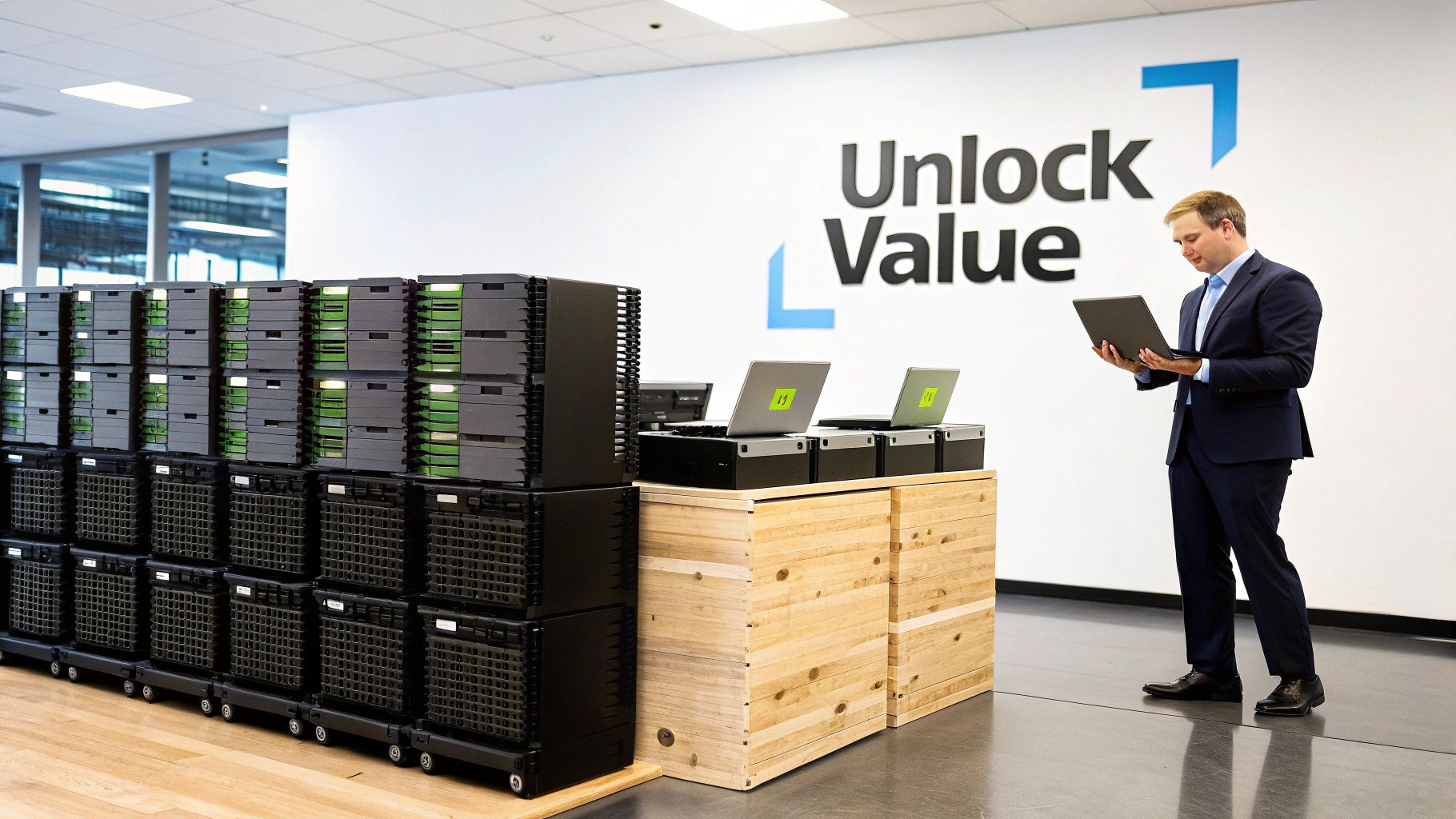
Why Asset Resale is a Smart Business Move
Professional IT asset resale is more than just receiving a check for old hardware; it's a comprehensive solution that addresses several core business challenges simultaneously. When managed by a certified partner, a resale program delivers tangible benefits that impact your bottom line, strengthen risk management, and enhance your corporate sustainability efforts.
Key advantages for your business include:
- Direct Revenue Generation: Instead of paying for equipment removal, you receive payment for it. This recovered capital can be reinvested into new technology or other strategic business priorities.
- Reduced Total Cost of Ownership (TCO): Recovering value from retired equipment effectively lowers the TCO of your original technology investment, improving ROI.
- Guaranteed Data Security: Partnering with a certified IT Asset Disposition (ITAD) firm ensures all data is destroyed according to stringent standards like NIST 800-88, protecting your business from a costly data breach.
- Enhanced Sustainability Profile: Responsible resale and recycling demonstrate a verifiable commitment to environmental stewardship, which can improve your brand's public image and align with corporate sustainability goals.
To maximize the return from your retired IT assets, a structured, professional process is essential. Below is a high-level overview of the professional IT asset resale strategy for businesses in Georgia.
Key Phases Of Professional IT Asset Resale
| Phase | Primary Goal | Key Business Considerations |
|---|---|---|
| Inventory & Assessment | Create a detailed list of all surplus assets to determine their condition and potential resale value. | Is the equipment functional? Are there any cosmetic issues? Is it enterprise-grade or consumer-grade? |
| Data Security & Sanitization | Securely erase all sensitive data from every device according to industry and regulatory standards. | Compliance with FTC Disposal Rule, HIPAA, or GLBA. Need for certified data destruction. |
| Valuation & Logistics | Accurately price the equipment based on market demand and coordinate secure transportation. | Current secondary market prices, logistics for pickup (palletizing, shrink-wrapping), chain of custody. |
| Remarketing & Resale | Find the right buyers through established channels to maximize the financial return. | Access to a network of vetted buyers, online marketplaces, direct sales. |
| Reporting & Documentation | Provide complete documentation, including certificates of data destruction and financial summaries. | Proof of compliance, asset tracking reports, final settlement statements. |
Each of these phases is critical for safely and efficiently turning surplus equipment from a liability into a valuable asset.
The core principle is simple: your used IT equipment is not worthless. With the right partner, it becomes a valuable, recoverable asset that can fund future growth and mitigate significant security risks.
To learn more about how this works for Georgia-based companies, explore our detailed overview of professional IT equipment resale in Georgia. Maximizing your return requires an expert partner who understands asset valuation, certified data sanitization, and complex logistics.
How to Prepare Your IT Assets for the Best Buyback Offer
Securing the best possible offer for your company's surplus electronics begins long before you request a quote. The preparation of your equipment directly impacts its final valuation. A disorganized pile of gear sends a starkly different message than a pallet of neatly organized, well-documented assets.
The single most critical action you can take is to create a clean, detailed, and accurate inventory of your servers, laptops, and networking equipment. This immediately demonstrates professional asset management and allows a partner like Beyond Surplus to provide a faster, more precise valuation.
First, Build a Solid Inventory List
A professional reseller’s first requirement is a comprehensive inventory. While it doesn't need to be overly complex, accuracy is non-negotiable.
Ensure your list captures these key details for each asset:
- Asset Type: Server, laptop, desktop, switch, firewall, etc.
- Brand and Model: Be specific (e.g., "Dell PowerEdge R740," "Cisco Catalyst 9300").
- Key Specs: CPU model, RAM amount, and hard drive details (capacity and type, such as SSD or HDD).
- Quantity: A simple count of identical units.
This inventory is the foundation of the entire resale process. It is what Beyond Surplus uses to develop a preliminary quote and plan the logistics for pickup.
Be Honest About the Condition
After completing your list, conduct a realistic assessment of each item's condition. Upfront honesty saves significant time and prevents complications later. Segregate your assets into straightforward categories.
Classify them as follows:
- Fully Functional: The equipment powers on and operates as intended, with no known issues.
- Minor Defects: The device is functional but may have cosmetic issues (e.g., scratches) or be missing a minor, non-critical component.
- Non-Functional/For Parts: The asset is inoperable. These items are designated for responsible recycling, not resale.
A pro tip from our years of experience: simple actions like wiping dust off a server or neatly bundling power cords can subtly enhance perceived value. It signals that the equipment was well-maintained, which often translates to a better final offer.
Get Your Gear Organized and Ready
Finally, physically organize the equipment. Consolidate everything into a secure, accessible location—a storage room or a designated warehouse area. Group similar items together: stack laptops neatly on a pallet, place servers on a rack, and box loose components like RAM sticks or CPUs.
This organization streamlines the pickup and auditing process. When our logistics team arrives to find everything consolidated and ready, it reduces our labor time and complexity—a savings we can pass on to you in your final payment.
These preparatory steps are more crucial than ever. The refurbished electronics market is projected to reach USD 37,123.88 million by 2033. For Georgia businesses, this growth means your properly prepared surplus hardware is a valuable asset. We regularly help companies recoup 30-50% of their original hardware expenditure through a strategic buyback program.
You can dive deeper into the trends shaping the global refurbished electronics market. With a small amount of preparation, you can transform decommissioning from a cost center into a significant revenue generator.
Ensuring Ironclad Data Security And Compliance
While surplus electronics in Georgia can be a source of revenue, data security must be the top priority. A single improperly wiped hard drive can lead to a catastrophic data breach, resulting in millions in fines, legal complications, and irreparable reputational damage.
For any Georgia business, particularly those in regulated sectors like healthcare, finance, or legal services, proper data destruction is the foundation of responsible IT asset disposition (ITAD). The moment a device leaves your control, you must have absolute confidence that all sensitive information has been permanently destroyed.
Certified Wiping Versus Physical Destruction
There are two industry-standard methods for data destruction. Understanding the difference is key to balancing security with maximizing the value of your assets.
Software-Based Data Wiping: We utilize certified software to overwrite every sector of a hard drive with random data. Performed to standards like NIST 800-88, this process renders the original information completely unrecoverable. This is the preferred method for newer, high-value drives as it preserves the hardware for resale.
Physical Destruction (Shredding): For older, faulty, or low-value drives, shredding provides the ultimate solution. Hard drives are fed into an industrial shredder that grinds them into small, unrecognizable metal fragments. This guarantees zero chance of data recovery but eliminates any resale value.
The choice depends on a simple cost-benefit analysis. A new, high-capacity SSD is a prime candidate for secure wiping to maximize its resale value. A decade-old hard drive with no market value should be shredded without hesitation.
This decision tree illustrates how we evaluate assets to determine their optimal outcome.
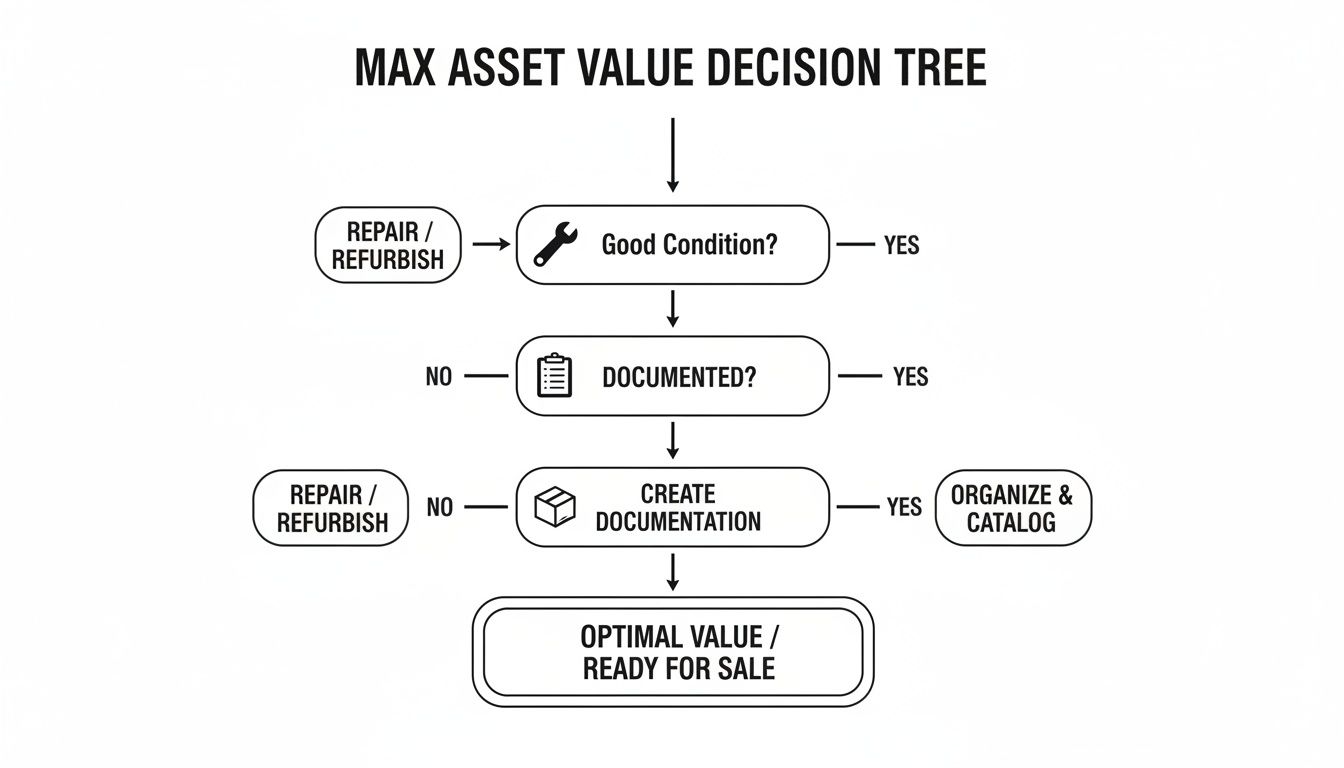
The key takeaway is that an asset's value is directly tied to its condition and the availability of proper documentation.
Choosing between wiping and shredding is a critical step. The following table provides a practical breakdown to help you match the right data destruction method to your needs, considering both security and value.
| Method | Ideal For | Key Compliance Alignment | Impact On Asset Value |
|---|---|---|---|
| Data Wiping (NIST 800-88) | Newer, functional hard drives, SSDs, and servers with resale potential. | HIPAA, GLBA, FTC Disposal Rule, SOX | Preserves Value. Allows for the reuse and resale of the hardware. |
| Physical Shredding | Old, damaged, or non-functional hard drives with no resale value. | HIPAA, DoD 5220.22-M, NSA/CSS SDM 9-12 | Destroys Value. Eliminates any possibility of resale. |
| Degaussing | Magnetic media like tape backups and older hard drives. | NSA, DoD standards for classified data. | Destroys Value. Renders hard drives unusable for resale. |
Your choice ultimately depends on whether you need to recover value or guarantee absolute data elimination. For most modern IT assets, a certified wipe provides the perfect balance.
Meeting Strict Compliance Mandates
Your data destruction process must align with legal and regulatory requirements. Non-compliance can lead to severe penalties, which is why professional handling is crucial.
Healthcare organizations in Georgia must adhere to HIPAA's strict rules on protecting electronic patient data. Financial institutions are governed by laws like the Gramm-Leach-Bliley Act (GLBA). The FTC Disposal Rule requires all businesses to take reasonable measures to protect consumer information during disposal.
The single most important document in this process is the Certificate of Data Destruction. This legally binding document lists the serial numbers of every drive wiped or shredded, formally transferring liability from your organization to your ITAD partner. Without it, you lack auditable proof of due diligence.
This documentation provides peace of mind and the necessary proof that you have met your compliance obligations.
For a deeper look into the technical and legal protections, review our guide to secure hard disk disposal to understand how our certified processes shield your business.
From Pickup to Payout: How Electronics Buyback Logistics Work
How do pallets of servers and bins of laptops transition from your facility to a payment for your business? With a professional ITAD partner, this logistical process is a transparent and streamlined journey designed for security and accountability.
The entire logistical chain is built to be efficient and minimally disruptive, whether we are clearing out a few server racks or decommissioning an entire data center for a Georgia-based client.
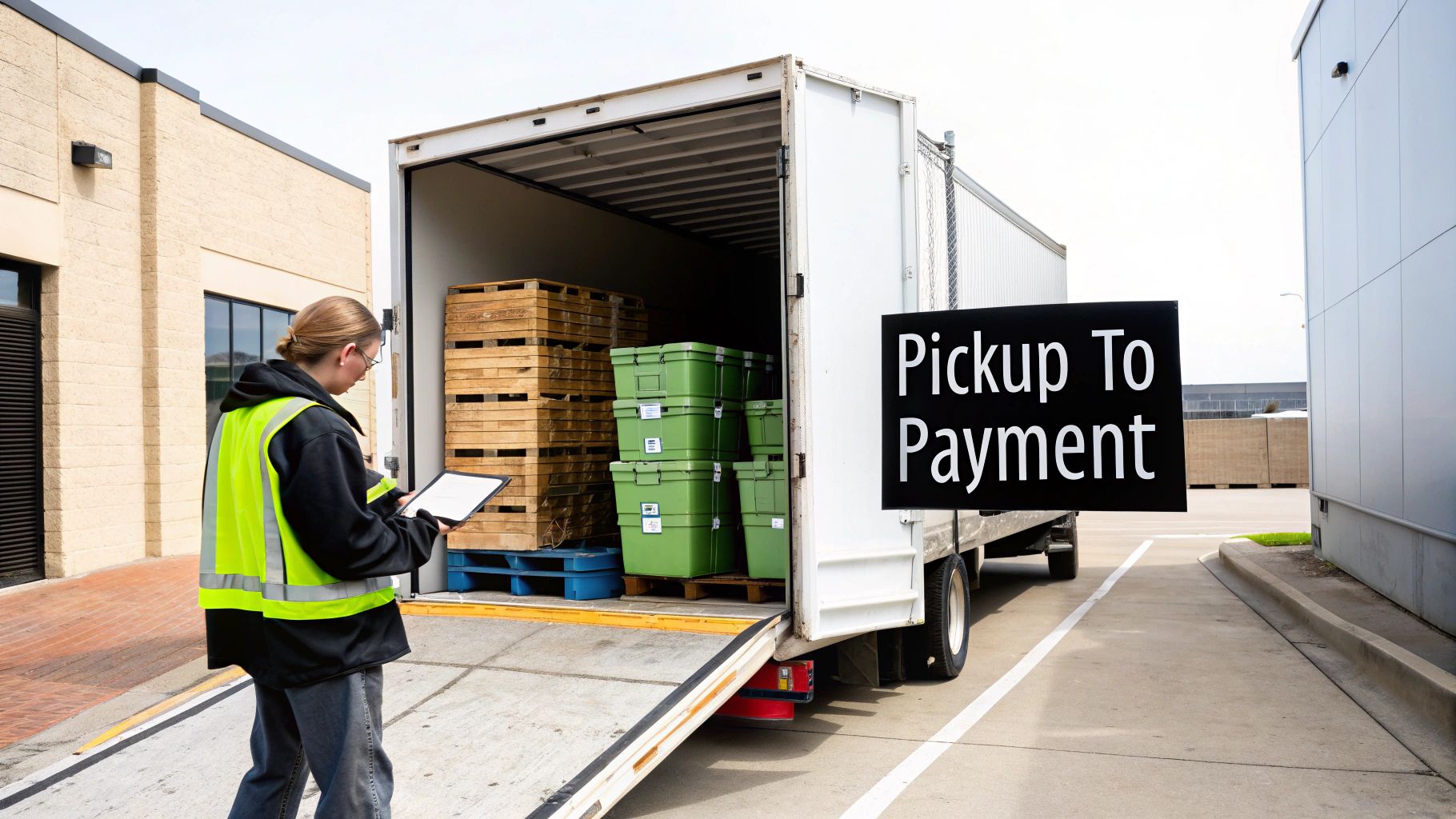
The process begins when you schedule a pickup. Our logistics team coordinates the appropriate vehicle and crew for the job, from a box truck for an office cleanout to a full-sized tractor-trailer for a major asset retirement project. Our objective is to complete the removal with minimal disruption to your daily operations.
Locking Down the Chain of Custody
From the moment our team arrives, every asset is managed under a strict chain-of-custody protocol. This is a documented security procedure, not just a simple move from point A to point B.
Each pallet, bin, or container is serialized, inventoried, and tracked from your location to our secure processing facility. This meticulous tracking provides a clear, auditable trail and ensures no assets are misplaced. For any organization concerned with risk management, this documented custody transfer is non-negotiable.
The Real Work: Auditing and Valuation
Upon arrival at our facility, our technicians audit every piece of equipment against your initial inventory list. This includes running diagnostics to verify functionality, confirming specifications like CPU and RAM, and assessing the cosmetic condition of each unit.
This hands-on audit transforms a preliminary estimate into a firm, final buyback offer. Valuations are based on real-time secondary market data for each specific model and configuration, ensuring you receive a fair and competitive price based on current demand.
Transparency is paramount. You will receive a detailed report breaking down the final value of each asset, noting any discrepancies such as non-functional units that must be routed for responsible recycling instead of resale.
Finalizing the Deal and Getting Paid
After you review and approve the final valuation report, we process the payment quickly, closing the loop on a successful asset recovery cycle. You will also receive all critical documentation for your records, including the final asset report and the official Certificates of Data Destruction and Recycling.
Logistical efficiency is crucial. The global market for reselling surplus electronic components is projected to reach USD 522 billion by 2032. As a major logistics hub, Atlanta is perfectly positioned to help Georgia businesses capitalize on this trend.
Preparing assets for transit requires understanding details like proper PCB Board HS Code classification for smooth logistics. To see how we manage the initial step, learn more about our professional IT equipment pickup services in Georgia.
Choosing The Right ITAD Partner In Georgia
The success of your electronics resale program depends on selecting the right ITAD partner. An experienced, certified provider does more than just purchase your old equipment; they act as a critical line of defense for your brand, your data, and your bottom line.
This choice transforms a logistical challenge into a strategic advantage. It's about finding a specialist who delivers a complete, end-to-end solution—providing peace of mind that the job was handled correctly, compliantly, and profitably.
Security and Compliance Guarantees
An expert ITAD partner guarantees ironclad security for your sensitive information. They provide certified data destruction that meets or exceeds standards like NIST 800-88, ensuring your data is 100% irrecoverable. This is essential for compliance with regulations like HIPAA, GLBA, and the FTC Disposal Rule.
Proper documentation is proof of this process. A reputable partner will always provide:
- Certificates of Data Destruction: Your auditable, legally binding record listing the serial numbers of every drive sanitized or destroyed.
- Certificates of Recycling: This document shows that non-viable assets were managed in an environmentally responsible manner, supporting your corporate sustainability goals.
This paperwork is your official record of due diligence, effectively transferring liability from your company to your ITAD partner.
Maximizing Financial Returns
The global market for second-hand electronics is projected to be worth USD 96,514.5 million by 2025. This creates a significant opportunity for businesses to generate cash back from their surplus IT assets. A partner like Beyond Surplus, located in the heart of Georgia, possesses the market knowledge and network to ensure you extract maximum value from your equipment. You can explore the growth of the second-hand electronics market and its implications for businesses.
A top-tier ITAD partner doesn't just process your assets; they analyze them. They understand the nuances of the secondary market and know how to identify the highest-value components, ensuring you don’t leave money on the table.
A Partnership Built on Trust
Ultimately, choosing an ITAD vendor is about establishing a reliable relationship. It requires a team that offers transparent reporting, secure logistics, and a clear chain of custody from the moment assets leave your facility. They should provide a single point of contact and a seamless process from pickup to final payment.
This level of service is necessary to manage the complexities of modern IT asset disposition. To see how a dedicated partner can streamline electronics resale in Georgia, review our overview of comprehensive ITAD services in Georgia, designed to protect your business and boost your bottom line.
Common Questions About Electronics Resale In Georgia
Here are straightforward answers to the most common questions we receive from businesses in Georgia regarding surplus electronics resale. This serves as a quick reference for making informed decisions about your retired IT assets.
What Types Of Electronics Have The Best Resale Value?
Enterprise-grade equipment consistently holds the most value. This includes recent-generation servers from brands like Dell and HP, networking gear from Cisco, and large quantities of corporate laptops or desktops that are not obsolete.
Individual components such as CPUs and RAM can also have value, particularly in bulk. The final offer is determined by age, condition, brand, and current secondary market demand. We evaluate each lot individually to maximize its value for you.
How Can I Be Certain My Company's Data Is Gone For Good?
Data security is non-negotiable. We provide a certified and transparent process to ensure your peace of mind. Our data security services include software-based wiping that meets or exceeds the rigorous NIST 800-88 standards. For maximum security, we also offer on-site or off-site hard drive shredding, which physically destroys the drives.
Upon completion, we issue a formal Certificate of Data Destruction. This critical document lists the serial numbers of every drive handled, providing an official, auditable record for compliance and legally transferring liability to us.
We Have Offices Outside Of Atlanta. Can You Still Help Us?
Yes. While our main facility is in Smyrna, Georgia, we provide comprehensive nationwide pickup services for enterprise clients across the United States. We manage all logistics, whether your assets are located at a single Georgia headquarters or distributed across multiple national offices.
For local businesses, we also offer a convenient drop-off service at our Smyrna facility. Our goal is to provide flexible options that align with your company's operational needs.
A common question is whether you pay a recycler or they pay you. For assets with sufficient market value, a reputable ITAD partner should pay your business. You can explore a detailed breakdown of when a business should expect payment versus when recycling fees may apply in our article on recycler payment models.
What Happens To Equipment That Can't Be Resold?
Any asset with no resale value is responsibly recycled according to R2 (Responsible Recycling) standards and all relevant environmental regulations. We maintain a strict zero-landfill policy, ensuring all materials—from plastics to precious metals—are handled sustainably.
For these assets, we provide a Certificate of Recycling. This document helps you formally demonstrate your company's commitment to corporate sustainability and environmental stewardship.