Selecting the right ESG recycling partner in Georgia is a critical business decision that directly impacts your brand reputation, data security, and financial bottom line. For Georgia-based companies, the focus must be on partnering with a certified, transparent provider who delivers a verifiable, auditable trail for every retired IT asset. When you find the right fit, IT asset disposition (ITAD) transforms from a compliance obligation into a powerful strategic advantage.
Why Your Business Needs a Strategic ESG Recycling Partner
The days of simply hauling away old office computers are over. Today, stakeholders—from investors to customers—demand demonstrable commitment to environmental, social, and governance (ESG) principles. Your IT asset disposition program is one of the most visible and measurable components of your ESG story.
A true partnership extends far beyond basic disposal. It involves building a documented, sustainable ITAD program that strengthens your annual ESG report and shields your organization from the catastrophic fallout of a data breach. This isn't just about avoiding fines for improper e-waste disposal; it's about building and preserving corporate trust.
To understand the full scope of benefits, it's essential to explore what an ESG-focused electronics recycling program in Georgia looks like in practice.
From Cost Center to Strategic Asset
Viewing electronics recycling as a mere business expense means missing significant opportunities. Engaging a strategic ESG recycling partner in Georgia can unlock hidden value and protect your business from substantial risks.
- Enhance Brand Reputation: A demonstrated commitment to secure and environmentally sound e-waste practices strengthens your corporate image and attracts clients who prioritize sustainability.
- Improve ESG Scores: A certified partner provides verifiable data, including landfill diversion rates and serialized Certificates of Data Destruction. This is concrete evidence for sustainability reports, which can significantly influence investors and industry analysts.
- Prevent Data Breaches: Professional ITAD services ensure all sensitive data on hard drives and other storage media is irretrievably destroyed, protecting you from costly breaches and legal repercussions.
- Ensure Regulatory Compliance: An expert partner navigates complex regulations like the FTC Disposal Rule and HIPAA, providing all necessary documentation to prove compliance.
A strong partner can also help you integrate other sustainability efforts, like industrial plastic recycling initiatives, further reducing waste and potentially improving your bottom line.
The crucial shift is to stop viewing retired IT assets as junk. Instead, see them as a collection of data, risk, and potential value. The right partner helps you manage all three, transforming a logistical challenge into a competitive advantage.
Core Traits of a Top-Tier ESG Recycling Partner
Identifying the right partner requires looking beyond a price quote. You need a company whose services directly support your ESG goals and deliver verifiable, transparent results. The table below outlines the key attributes to seek.
| Attribute | What It Means for Your Business | Direct ESG Impact |
|---|---|---|
| Certified Processes | They hold certifications like R2v3 or e-Stewards, proving they follow strict industry standards. | (E) Guarantees responsible handling of hazardous materials and maximizes resource recovery, reducing your environmental footprint. |
| Auditable Data Security | You receive serialized Certificates of Data Destruction for every single hard drive. | (S & G) Protects customer and company data, demonstrating strong governance and social responsibility by preventing data breaches. |
| Transparent Chain of Custody | You get detailed reporting that tracks your assets from your door to their final disposition. | (G) Provides the auditable trail needed for compliance and ESG reporting, showcasing excellent corporate governance. |
| Downstream Vendor Vetting | They thoroughly vet all their own partners to ensure the entire recycling chain is secure. | (E & S) Prevents your e-waste from being illegally exported or improperly handled, protecting both the environment and vulnerable communities. |
| Focus on Reuse & Repair | They prioritize refurbishing and reselling viable equipment before resorting to recycling. | (E & S) Extends the life of electronics, reducing the demand for new manufacturing and often allowing for donations to schools or non-profits. |
Ultimately, a partner exhibiting these traits doesn't just dispose of your assets; they become an extension of your own commitment to corporate responsibility, providing the documentation and peace of mind you need to focus on your core business.
Your Vetting Checklist for Potential Recycling Partners
Finding the right ESG recycling partner in Georgia means separating true industry leaders from companies merely "greenwashing" their services. A genuinely accountable partner does more than pick up old equipment; they deliver a verifiable, legally defensible process that protects your business.
This requires digging deeper than a generic checklist. It's time to pressure-test their claims with pointed, specific questions.
Start by demanding proof, not just promises. Don't just ask if they provide a Certificate of Data Destruction; ask to see a redacted example. A certificate from a top-tier partner will be serialized, listing every asset by its unique serial number. It will also detail the exact destruction method used, whether that was a multipass data wipe or physical shredding.
This level of detail is critical. A simple receipt or a non-serialized certificate offers zero protection if one of your assets is later found in a dumpster. This is the difference between a simple transaction and a legally defensible chain of custody that shields your business from downstream liability.
Beyond the Minimum Certifications
Industry certifications like R2v3 are an excellent starting point, but they should be treated as the bare minimum. A standout ESG recycling partner in Georgia will not only hold the certification but will also be completely transparent about their downstream vendor network—the other companies they use to process materials.
Ask any potential partner these questions:
- Can you provide a list of your primary downstream partners?
- How do you audit them to ensure they also adhere to R2v3 or e-Stewards standards?
- Are you open to an on-site or virtual tour of your processing facility?
A reputable vendor will welcome this scrutiny. If you get a tour, look for organized, secure processing areas and a clear separation of materials. A messy, disorganized facility is a major red flag for sloppy security and environmental practices.
We’ve heard stories from facility managers who caught vendors cutting corners on data security just by observing their process. A partner who restricts access or is vague about their procedures may have something to hide. Transparency is everything.
Pressure-Testing Data Security Protocols
In IT asset disposition, data security is arguably the most critical component. A data breach from a single mishandled hard drive can inflict catastrophic financial and reputational damage on your company.
The process below illustrates how compliance, brand trust, and security are interconnected in a strategic recycling program.
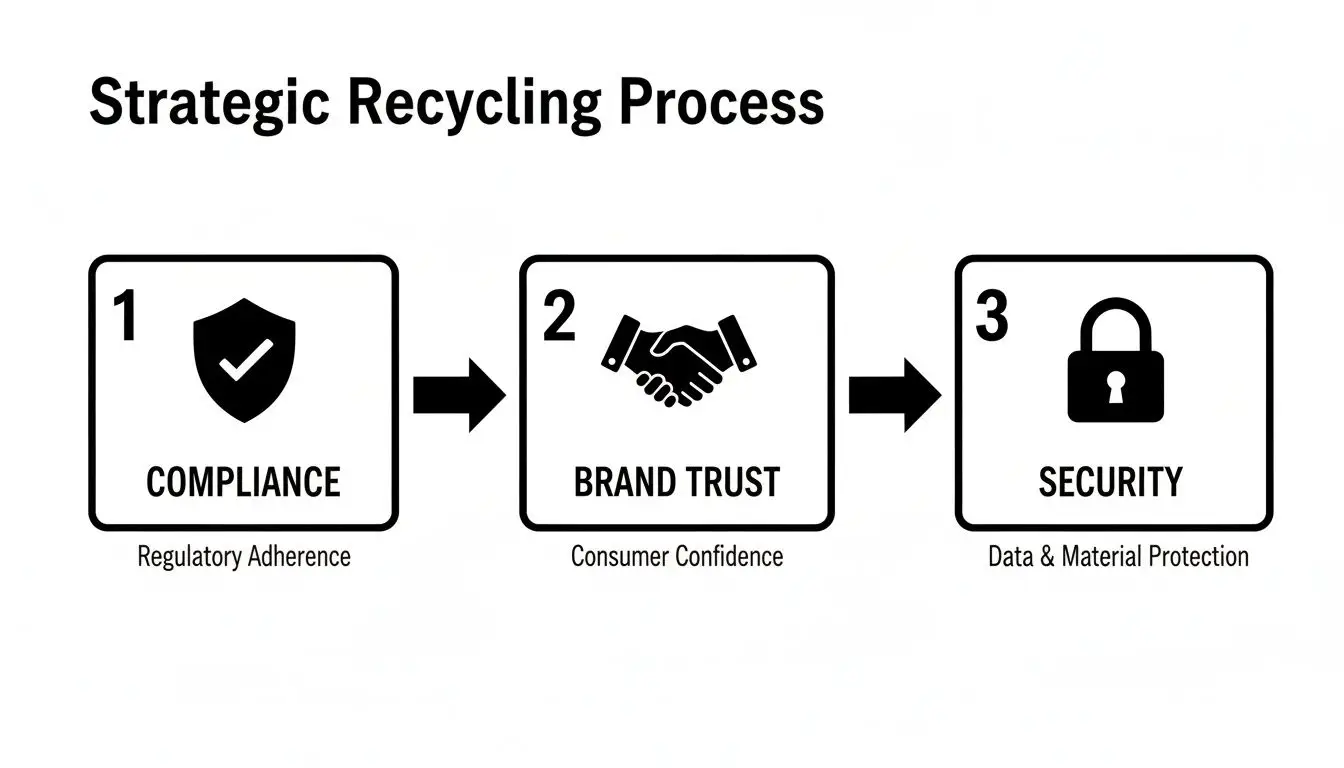
As you can see, a failure in one area, like security, directly threatens your compliance status and brand integrity. When vetting a partner, you must dig deep into their security measures.
To gain a real sense of their commitment, ask about their approach to social impact. For a closer look, check out our guide on social impact recycling in Georgia and see how responsible ITAD can also benefit the community. A dedication to social good is often a powerful indicator of a company’s overall ethical framework.
Navigating Compliance and Strengthening Your ESG Reporting
Compliance is no longer just a box to tick—it's a story you need to tell. A true ESG recycling partner in Georgia helps your business navigate the complex web of regulations, transforming compliance work into powerful data for your ESG reports. This approach converts a legal necessity into a strategic advantage that resonates with investors, customers, and stakeholders.
Imagine being able to show investors not just that you recycled, but that you diverted a specific number of kilograms of e-waste from Georgia landfills. That level of detail demonstrates serious commitment to responsible corporate governance.

From Paperwork to Powerful ESG Metrics
The real value emerges when you turn standard ITAD documentation into compelling ESG data points. A serialized asset report from a certified vendor isn't just a receipt; it's a verifiable record of your company's actions. This document is the bedrock for reporting tangible wins for your environmental and governance metrics.
Your partner should provide reports that clearly quantify:
- Total Weight Diverted: The exact kilograms or tons of electronic waste kept out of local landfills.
- Data Security Assurance: A count of every data-bearing device that was securely sanitized or physically destroyed, complete with matching serial numbers.
- Commodity Recovery: A breakdown of the raw materials like steel, aluminum, and plastics that were successfully recovered and returned to the supply chain.
This is the kind of data that allows you to move beyond vague sustainability claims. Instead of saying you "recycle responsibly," you can report that you "diverted 4,500 kilograms of e-waste and ensured the certified destruction of 580 hard drives in Q3." Now you are speaking a language that auditors and investors understand and respect.
The best partners don't just hand you a Certificate of Destruction. They provide the building blocks for a powerful story about your company's commitment to protecting data and the planet, strengthening your standing with stakeholders who prioritize corporate responsibility.
Meeting Industry-Specific Mandates
For many Georgia businesses, compliance extends beyond general e-waste rules. Industries like healthcare and finance face strict, specific mandates with severe penalties. A partner who understands these regulations is essential.
HIPAA in Healthcare: Medical facilities must guarantee that all patient data (ePHI) on retired equipment is destroyed beyond recovery. Your recycling partner must offer a HIPAA-compliant process, sign a Business Associate Agreement (BAA), and provide serialized Certificates of Data Destruction.
FTC Disposal Rule for Finance: Financial institutions must adhere to the FTC Disposal Rule, which mandates the proper disposal of consumer report information. This requires a documented, secure process for any device that has stored customer data.
Working with an expert who understands these nuances isn't just about avoiding fines; it's about building a defensible compliance program that becomes a key part of your governance strategy. Centralizing this process with a single certified vendor creates a consistent, auditable trail that holds up under scrutiny.
As you build out your sustainability initiatives, exploring concepts like carbon offset electronics recycling in Georgia can add another impressive layer to your ESG story, demonstrating a comprehensive approach to environmental stewardship.
Aligning Logistics and Service Level Agreements with Your Needs
The best recycling partnership on paper is meaningless if the execution is flawed. When moving retired IT assets from your facility to a processor, logistics can be a smooth, secure process or a significant point of failure. This is where the partnership's true value is defined.
The details of that process, along with the commitments in your Service Level Agreement (SLA), determine a partner's worth.
A one-size-fits-all approach to logistics is inadequate. Your needs for a multi-site office refresh in Atlanta differ from those for a data center decommissioning in Augusta. A qualified ESG recycling partner in Georgia must offer flexible services that align with your business operations.
Tailoring Logistics to Your Project Scope
For routine, smaller-scale asset retirements, scheduled pickups are an ideal solution. This typically involves the partner providing secure, locked bins or Gaylord boxes that your team fills over time, with pickups arranged at regular intervals. It’s an efficient way to manage the steady stream of old laptops, monitors, and peripherals from daily operations.
For large-scale projects—such as a full office cleanout or retiring an entire server farm—palletized freight shipments are required. Your partner should manage the entire process, from supplying pallets and packing materials to coordinating a secure, dedicated truck.
For Georgia businesses, there’s a massive security advantage in choosing a partner with its own GPS-tracked fleet. This setup eliminates the risk of third-party logistics (3PL) providers and creates a direct, unbroken chain of custody from your loading dock to their secure facility.
Crafting an Ironclad Service Level Agreement
An SLA is the official rulebook for your partnership, not just another contract. It sets clear expectations, defines responsibilities, and establishes recourse if service levels are not met. Without a detailed SLA, you operate on ambiguity and invite risk.
Your SLA must be built around specific, measurable performance indicators. Vague promises are insufficient. Insist on concrete timelines and standards you can track.
Key clauses to demand in your SLA include:
- Pickup Response Time: Be specific. For example, "Pickups for standard requests will be scheduled within 3-5 business days."
- Reporting Delivery Window: Define when you receive final paperwork, such as, "Certificates of Data Destruction and Recycling will be delivered no later than 30 days after asset receipt."
- Asset Reconciliation: The agreement must guarantee a full reconciliation of the assets picked up against the final processing report.
- Data Security Procedures: The SLA should explicitly name the data destruction standards used (like NIST 800-88) and confirm compliance with key regulations like HIPAA or the FTC Disposal Rule.
To help you drill down on what to ask, we've compiled critical questions for your next Request for Proposal (RFP). These are designed to cut through sales pitches and get to the core of a vendor's capabilities.
Essential RFP Questions for Your Next Recycling Partner
| Evaluation Category | Key Question to Ask |
|---|---|
| Security & Chain of Custody | "Describe your end-to-end chain-of-custody process, including transportation. Do you use your own fleet or a third-party logistics (3PL) provider?" |
| Data Destruction | "Which data destruction standards (e.g., NIST 800-88, DoD 5220.22-M) do you adhere to, and can you provide serialized Certificates of Data Destruction?" |
| Environmental Compliance | "What certifications (e.g., R2, e-Stewards) does your facility hold, and can you provide a copy of your downstream vendor policy?" |
| Reporting & Transparency | "What specific ESG and compliance metrics are included in your standard asset settlement report, and can reports be customized to our needs?" |
| Logistics & On-Site Services | "What on-site services do you offer for large-scale projects, such as asset decommissioning, packing, and palletizing?" |
Using these questions will provide a much clearer picture of a potential partner, ensuring you find one who can truly meet your security and ESG goals.
Familiarizing yourself with secure transport options will help you make a smarter choice. Our guide on e-waste pickup services in Georgia breaks down what you should expect. A well-written SLA transforms a vendor into an accountable partner, protecting your company by leaving no room for error.
Unlocking Value Recovery and Financial Returns from Old IT
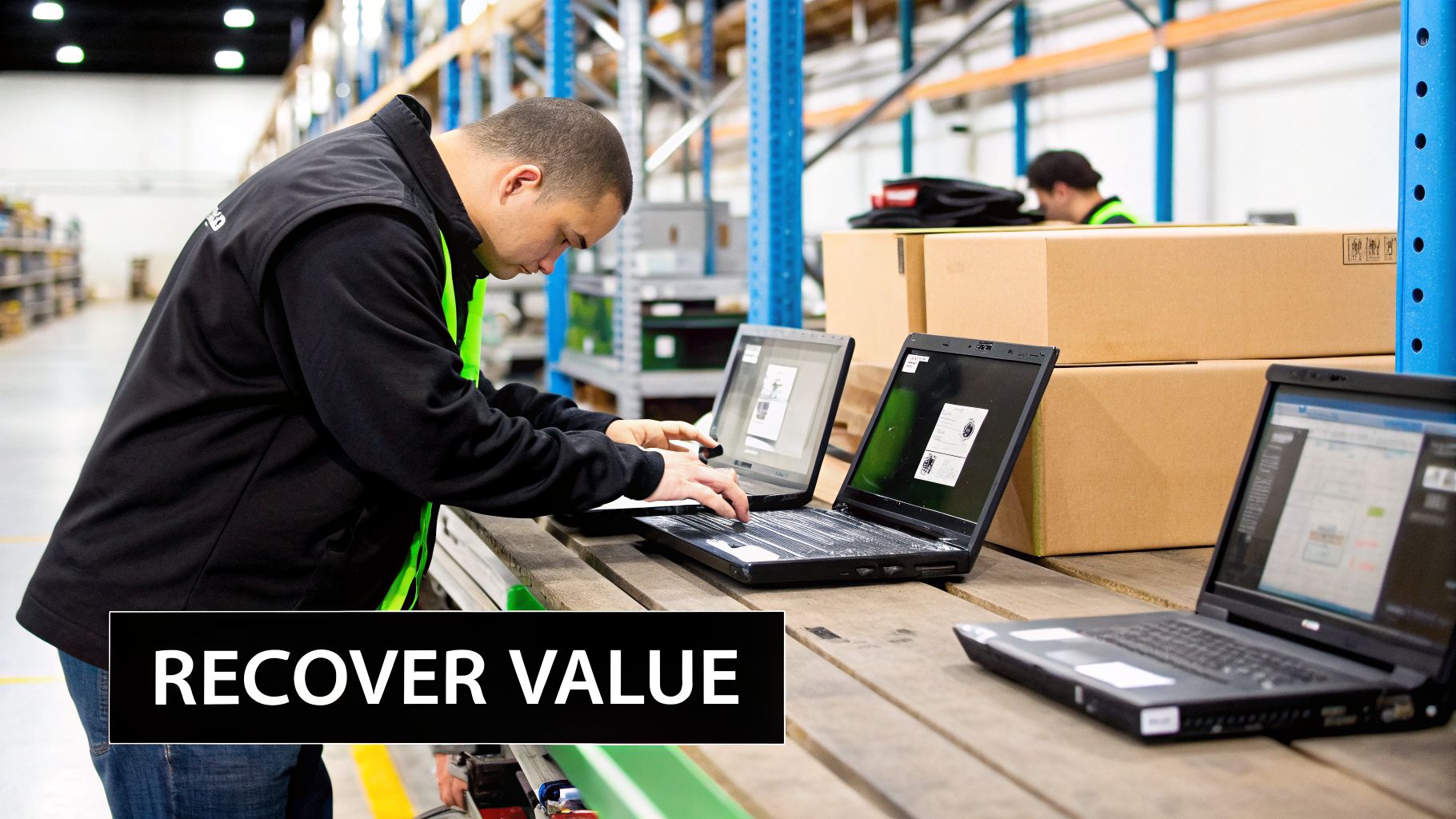
Most businesses in Georgia view old IT equipment as a liability. However, what if retiring those assets could become a source of revenue? This is achievable through a process called IT Asset Value Recovery (ITAVR), which turns old technology into a financial return while meeting your ESG targets.
An expert ESG recycling partner in Georgia knows how to identify the hidden value in your used equipment. Recent-model laptops, enterprise servers, or networking gear you consider obsolete often have a strong secondary market value. The right partner has established remarketing channels to sell these assets for their true worth.
Preparing Assets to Maximize Resale Value
The condition of your assets at the time of pickup directly impacts their resale value. A few simple steps can make a significant financial difference, ensuring your partner can achieve the highest possible return for you.
Here are a few tips to maximize your financial return:
- Handle with Care: Avoid piling equipment. Stacking can cause scratches, cracked screens, and other cosmetic damage that diminishes value. Store assets securely until pickup.
- Keep Components Together: Ensure laptops have their power adapters and servers have their drive caddies. A complete unit is always worth more.
- Do Not Remove Parts: Resist the temptation to harvest components like RAM or hard drives, unless it is a strict part of your security protocol. Missing parts can eliminate an asset's resale value.
- Provide Detailed Lists: If possible, compile an inventory list with the make, model, and known specs. This helps your partner quickly identify high-value items and bring them to market faster.
The most impactful change is shifting your perspective from "getting rid of junk" to "recovering value." Your goal is to preserve the asset's condition from the moment it’s unplugged until it arrives at your partner's facility.
Ensuring Transparency with Revenue-Sharing Reports
A trustworthy partnership is built on transparency, especially when finances are involved. Any credible ITAD vendor will provide a clear, detailed revenue-sharing report that breaks down the entire process. This is non-negotiable.
Your report should clearly show:
- A serialized list of every asset that was resold.
- The gross sale price for each individual item.
- Any service costs, such as data destruction, testing, or logistics fees.
- The final net revenue and your exact share, based on the agreed-upon percentage.
This level of detail changes the conversation from the cost of recycling to the ROI of a smart, sustainable ITAD program. To learn more about how this works, you can explore Beyond Surplus’s asset recovery services in Georgia and see how we structure our value-sharing model. This approach not only benefits your budget but also strengthens your ESG credentials by turning a liability into a documented financial and environmental win.
Common Questions About ESG Electronics Recycling
Even with a well-defined plan, questions will arise when selecting an ESG recycling partner in Georgia. For businesses across the state, getting clear answers from the start builds confidence and prevents future confusion.
We frequently hear the same questions from IT and facility managers, so let's address them directly.
What Is The Real Difference Between R2 And e-Stewards Certifications?
Both R2 and e-Stewards are top-tier, globally recognized standards, but they have different focuses. R2 (currently R2v3) emphasizes the entire asset lifecycle, including repair and reuse. It adopts a flexible, risk-based approach to managing downstream vendors and prioritizes keeping materials in a circular economy.
Conversely, e-Stewards is known for its stricter, more prescriptive rules, particularly its absolute ban on exporting hazardous e-waste to developing nations. A premier partner will often hold both certifications, providing complete assurance that all bases are covered. For a deeper dive, our guide on what IT asset disposition truly entails is a valuable resource.
How Can I Be 100% Certain Our Data Is Destroyed?
Absolute certainty comes from auditable proof. Always demand a serialized Certificate of Data Destruction. This is not a generic receipt but a detailed report listing every asset by its unique serial number.
The certificate must also state the exact destruction method used, whether it’s a NIST 800-88 compliant multi-pass wipe or physical shredding.
For ultimate peace of mind, especially with highly sensitive data, ask about on-site shredding services. This allows you or a team member to physically witness the hard drives being destroyed at your facility before they leave the premises.
What Happens To IT Equipment That Has No Resale Value?
Assets that cannot be refurbished or resold enter the commodity recovery stream, which is a key part of the "E" in ESG. The equipment is de-manufactured—broken down into its core materials like steel, aluminum, plastic, and precious metals—at a certified downstream processing facility.
These raw materials are then sorted and shipped to approved smelters and refineries. From there, they are reintroduced into the global manufacturing supply chain to create new products. This is what "closing the loop" means and is a cornerstone of any legitimate ESG program.
Do You Handle Large-Scale Pickups Outside The Atlanta Metro Area?
Yes, a full-service provider must offer robust logistics for major projects anywhere in Georgia and often nationwide. For large projects like data center decommissioning or multi-site cleanouts, your partner should coordinate the entire process.
This includes providing secure, palletized freight shipping to ensure every asset is handled consistently under a single chain of custody. Whether your project is in Savannah, Macon, or spread across different states, a capable partner will manage the secure transport from start to finish.
When you are ready to partner with a certified expert for your IT asset disposal needs, Beyond Surplus is here to help. We provide secure, transparent, and ESG-focused electronics recycling services for businesses across Georgia. Contact us today for a consultation.