For commercial businesses across Georgia, managing end-of-life electronics is no longer a simple matter of clearing out a storage closet. It has evolved into a critical component of data security, environmental stewardship, and regulatory compliance. As Georgia's technology and business sectors expand, the volume of outdated IT equipment grows in tandem. Implementing a professional strategy for e-waste recycling in Georgia is not just an operational task—it is a mandatory risk management function for any forward-thinking enterprise.
Navigating Georgia's Commercial E-Waste Landscape
The primary challenge for Georgia businesses is not merely disposing of old equipment, but doing so in a secure, compliant, and responsible manner. Improper disposal can lead to severe consequences, including data breaches from un-sanitized hard drives, significant environmental fines, and damage to corporate reputation. This is precisely where a certified IT Asset Disposition (ITAD) strategy becomes an indispensable solution for modern companies.
Unlike basic recycling services, a professional e-waste partner provides a structured, documented process that protects your organization from pickup to final disposition. It transforms a potential logistical and legal liability into a strategic advantage, ensuring both compliance and complete peace of mind.
The Growing Need for Professional E-Waste Services
Georgia is rapidly emerging as a key hub for electronics recycling, driven by the increasing volume of e-waste generated by businesses and significant investments in the state's processing infrastructure. The U.S. electronic goods recycling industry is projected to reach $27.7 billion in revenue by 2025, following a 4.8% annual growth rate over the last five years. In 2023, the nation produced 6.9 million tons of e-waste, underscoring the immense scale of the materials requiring management.
While Georgia does not currently mandate a statewide ban on e-waste from commercial landfills, substantial investments in local processing capabilities signal a growing confidence in the state's capacity to meet this demand.
A professional e-waste partner doesn't just dispose of your assets; they protect your data, ensure compliance, and manage your liability through a certified, auditable process. This is the core difference between simple disposal and strategic ITAD.
Why a Certified Partner Is Essential for Businesses
Selecting the right partner is critical to ensuring every piece of equipment is handled according to the highest industry standards. The objective is to convert a potential liability into a secure, closed-loop process.
Key benefits of partnering with a certified provider include:
- Guaranteed Data Security: Certified data destruction methods are used to permanently eliminate sensitive information from hard drives and other storage media, without exception.
- Regulatory Compliance: A professional service ensures adherence to regulations like the FTC Disposal Rule and HIPAA, providing the necessary documentation for audits.
- Environmental Responsibility: Certified partners guarantee that hazardous materials are managed safely and valuable resources are recovered, aligning with corporate sustainability initiatives.
By implementing a professional ITAD program, Georgia businesses can confidently manage their end-of-life electronics. You can explore the specific Georgia electronics waste recycling service areas we cover to see how we can support your organization.
Why Secure IT Asset Disposition Is Non-Negotiable for Businesses
For any business in Georgia, viewing IT Asset Disposition (ITAD) as merely another form of recycling is a significant oversight. ITAD is a comprehensive security protocol for your company's retired electronics, designed to shield your organization from tangible threats long after a device is decommissioned.
Improper disposal of IT equipment leaves your organization vulnerable. The risks are substantial and the consequences can be severe, ranging from damaging data breaches to major financial penalties under federal regulations like the FTC Disposal Rule and HIPAA.
Differentiating ITAD from Standard Recycling
The distinction between basic e-waste recycling in Georgia and a certified ITAD strategy lies in security, liability, and documentation. While both processes aim to divert electronics from landfills, their methodologies and objectives differ significantly. Standard recycling primarily focuses on material recovery.
A professional ITAD service, however, prioritizes data security above all else. The process establishes a meticulous, auditable trail that verifies every asset was handled according to strict security protocols. For IT managers and compliance officers, this means transferring liability and obtaining undeniable proof of due diligence. To understand this critical business function in more detail, you can learn more about IT Asset Disposition.
Core Components of a Secure ITAD Process
A robust ITAD strategy is founded on several non-negotiable pillars that work in concert to protect your company's sensitive information.
Key security measures include:
- Chain-of-Custody Documentation: This detailed, unbroken record tracks your assets from the moment they leave your facility to their final disposition, serving as auditable proof of secure handling.
- Certified Data Wiping: Professionals utilize software that meets or exceeds NIST 800-88 standards to overwrite all data on a storage device, rendering it completely unrecoverable.
- Physical Hard Drive Shredding: For the highest level of security, physical destruction is unmatched. Hard drives are pulverized into small fragments, guaranteeing that data can never be accessed again.
These are not optional services; they are fundamental components of any legitimate ITAD program.
Think of it this way: simply recycling a server without certified data destruction is like leaving the keys in your company vehicle after selling it. You've transferred the asset, but you haven't secured the sensitive information it once held.
The High Cost of Negligence
Failing to implement a secure ITAD program can result in significant financial consequences. A single improperly handled hard drive can contain proprietary company data, customer lists, or employee records. A data breach traced back to discarded equipment can lead to devastating financial losses, complex legal battles, and permanent damage to your brand's reputation.
Furthermore, federal and industry-specific regulations carry substantial penalties. HIPAA violations, for instance, can result in fines reaching millions of dollars for healthcare organizations. The FTC Disposal Rule applies to nearly all businesses and mandates the proper disposal of consumer information.
Ultimately, secure ITAD is not a cost center; it is an investment in risk mitigation. When you partner with a certified provider for e-waste recycling in Georgia, you are not just disposing of old equipment. You are actively protecting your business's future, safeguarding its reputation, and ensuring legal compliance.
Unlocking The Value In Your Retired IT Assets
For many Georgia businesses, a storage room filled with outdated IT equipment represents a logistical challenge and a disposal cost. However, a strategic approach can transform this liability into a tangible financial asset. With the right partner for e-waste recycling in Georgia, you can turn retired hardware into a source of capital.
This is achieved through specialized programs that recognize the residual market value in used, enterprise-grade electronics. Even when servers, laptops, and networking equipment no longer meet your organization's performance standards, their components—processors, memory, storage—can often be refurbished and resold. This is the essence of value recovery.
The Financial Upside: IT Equipment Buyback Programs
IT buyback programs provide a direct path to converting retired hardware into working capital. Instead of paying for removal, your business receives payment for assets that retain value. This revenue can offset the cost of new equipment and improve the financial efficiency of your entire IT lifecycle.
The process is straightforward:
- Asset Evaluation: A certified partner assesses your inventory of servers, laptops, networking gear, and other equipment to determine its fair market value.
- Secure Logistics: All assets are securely collected and transported from your facility to a processing center.
- Data Destruction: Your data is permanently erased using certified, documented methods to ensure complete security.
- Value Recovery: You receive payment for the equipment that is remarketed, turning a cost center into a revenue stream.
By integrating this into your IT asset management plan, you establish a predictable and profitable end-of-life process. Explore how Beyond Surplus's IT equipment buy back services can maximize the return on your retired technology.
The Environmental Return on Investment
Beyond direct financial benefits, a professional e-waste program delivers a significant environmental return. Electronics recycling is fundamentally about resource conservation. Extracting and processing raw ore is an energy-intensive and environmentally damaging process. In contrast, recycling a circuit board is like tapping into an "urban mine"—a rich, pre-processed source of valuable materials ready for reclamation.
This approach dramatically reduces energy consumption and carbon emissions. The environmental benefits of recycling in Georgia are substantial. For instance, recycling one ton of plastic can save approximately 5,800 kWh of energy. A study by the Georgia Department of Community Affairs highlighted the potential for savings by noting the disposal of 1 million tons of plastics and 0.36 million tons of metal annually. The Drawdown Georgia team projects that improving recycling rates could reduce emissions by 1.72 megatons of CO2e by 2030. You can find more details in this assessment of waste recycling capacity in Georgia.
Partnering with a certified e-waste recycler isn't just an operational decision. It's a strategic move that strengthens your company’s sustainability credentials, enhances your brand reputation, and shows a real commitment to corporate responsibility.
Here’s a quick look at how the financial and environmental benefits line up for different types of equipment.
Value Recovery Vs. Environmental Impact Of E-Waste Recycling
This table offers a comparative look at the financial returns and sustainability gains from professionally managing different types of IT assets.
| IT Asset Type | Potential For Value Recovery (Buyback) | Key Environmental Benefit Of Recycling | Associated Compliance Risk If Improperly Handled |
|---|---|---|---|
| Enterprise Servers | High (CPUs, RAM, HDDs) | Recovers precious metals like gold, silver, and palladium. | High: Data breach risk from storage media; hazardous materials in components. |
| Business Laptops | Moderate to High | Conserves aluminum, copper, and plastic; prevents battery chemicals from leaking. | High: Significant data breach risk; battery fire hazards. |
| Networking Gear | Moderate (Switches, Routers) | Reduces demand for newly mined copper and rare earth elements. | Moderate: Configuration data can pose a security risk. |
| Desktop Computers | Low to Moderate | Prevents lead and mercury from monitors and circuit boards from entering landfills. | High: Data breach risk from hard drives. |
| Mobile Devices | Varies (Model Dependent) | Reclaims valuable and conflict minerals like cobalt and lithium. | High: Extreme data privacy risk; battery fire hazards. |
This dual benefit—recovering capital and protecting the environment—is the hallmark of a modern ITAD strategy. It demonstrates that responsible environmental practices and sound financial management are mutually reinforcing. By unlocking the value in your retired assets, your organization contributes to a circular economy while improving its own financial health.
Your Step-By-Step Business E-Waste Recycling Process
Establishing a compliant e-waste recycling program in Georgia for your business can be a streamlined and efficient process. For IT managers, facility managers, and business owners, the right methodology transforms a complex task into a manageable workflow. This is our practical, step-by-step guide to executing it successfully.
By following these steps, you can confidently manage your company's IT asset disposal, ensuring complete security, compliance, and operational efficiency.
Step 1: Inventory and Segregate Your Assets
First, you must know exactly what you are dealing with. Begin by creating a detailed inventory of every IT asset designated for disposal, including servers, laptops, desktops, networking gear, and any other electronic equipment.
For each item, record key details such as asset tag, serial number, and device type. This list forms the basis of your chain-of-custody documentation, making it essential for tracking and final reporting. Once inventoried, physically segregate these assets in a secure, designated area to prevent them from being returned to active use.
Step 2: Schedule A Secure Pickup
With your inventory complete, contact a certified ITAD partner. Schedule a secure pickup from your Georgia facility at a time that minimizes disruption to your business operations.
During this coordination, provide your asset list and discuss any specific requirements, such as on-site hard drive shredding or special handling for sensitive equipment. Clear communication at this stage ensures a seamless pickup process.
Step 3: On-Site Packaging and Secure Transport
On the scheduled day, the ITAD provider’s logistics team will arrive at your location. They will securely pack and palletize all items on your inventory list, ensuring they are protected during transit. Each pallet or container is logged against your inventory before leaving your premises.
This step is critical for maintaining an unbroken chain-of-custody. The equipment is then loaded into secure, GPS-tracked vehicles and transported directly to a certified processing facility, eliminating unauthorized stops and access risks.
This simple infographic shows how retired IT assets are turned into real value for your business through a certified recycling process.
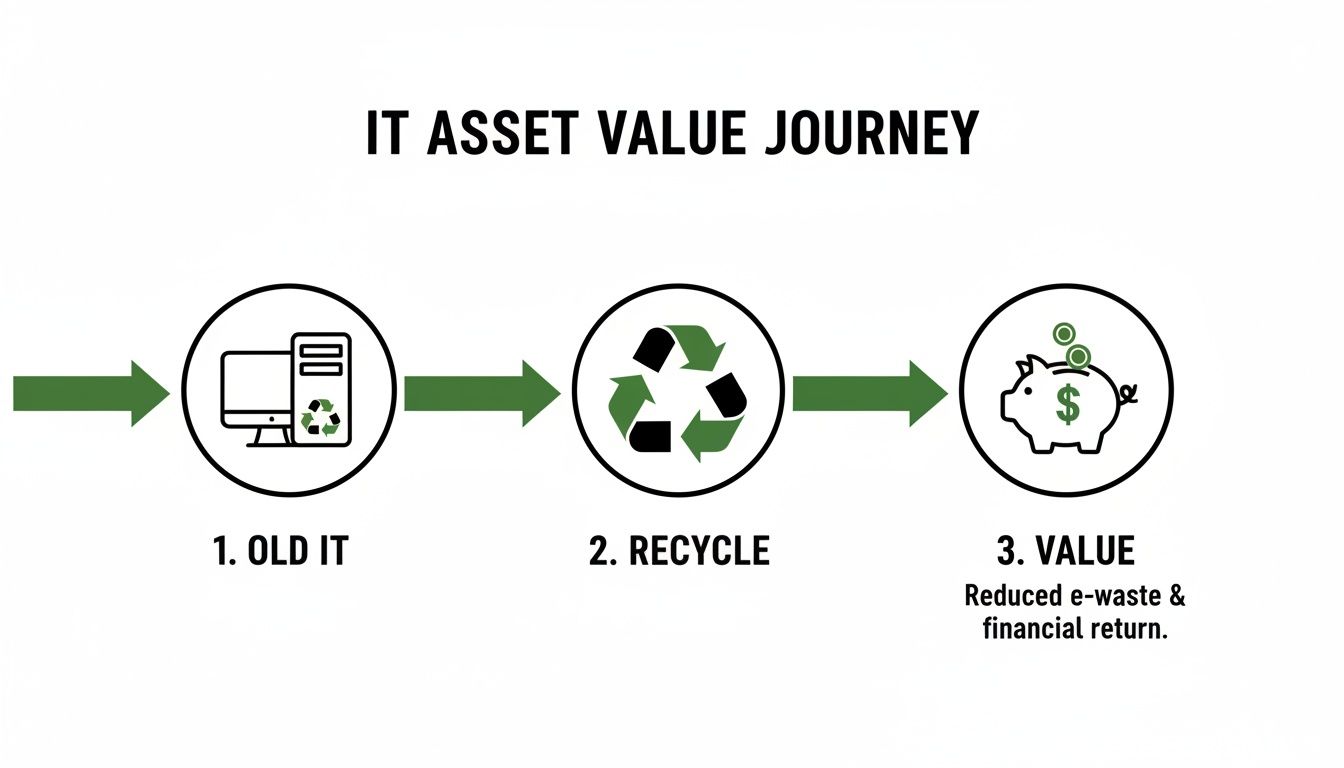
It’s a powerful journey: old equipment goes in, and recovered value comes out, all while supporting a circular economy.
Step 4: Certified Data Destruction
Upon arrival at the secure facility, the most critical phase begins: data destruction. A certified partner will process every data-bearing device according to strict, non-negotiable protocols.
Data destruction methods include:
- Certified Data Wiping: Using specialized software that meets NIST 800-88 standards to completely overwrite data, leaving it impossible to recover.
- Physical Shredding: Hard drives and other storage media are physically torn into tiny fragments. It’s the ultimate guarantee of data security.
The entire process is meticulously documented. Serial numbers are scanned and logged to create a clear, auditable trail of destruction for every single drive.
The Certificate of Data Destruction you get isn't just a piece of paper. It's your legal proof that you did your due diligence to protect sensitive information, effectively transferring liability from your organization to your certified partner.
Step 5: Receive Final Documentation and Reporting
The final step is receiving your official documentation. Your ITAD partner will provide a complete reporting package confirming that all assets were handled correctly and in full compliance with regulations.
This package should always include:
- A Certificate of Recycling: This confirms your e-waste was processed in an environmentally sound way.
- A Certificate of Data Destruction: This lists the serial numbers of every destroyed hard drive, acting as your official compliance record.
- A Detailed Asset Report: This reconciles the final processed items with the inventory list you created in Step 1.
Retain these documents as your auditable proof of compliance with regulations like HIPAA, FACTA, and the FTC Disposal Rule. This closes the loop on a fully documented, secure, and defensible e-waste recycling process for your Georgia business. For more details, review this computer recycling step-by-step guide.
How To Choose A Certified E-Waste Recycling Partner
Selecting a partner for e-waste recycling in Georgia is a decision that extends far beyond simple disposal. It directly impacts your company's data security, legal compliance, and brand reputation. Not all vendors operate under the same standards, and the stakes are too high for a business to choose based on cost or convenience alone.
The right partner functions as an extension of your risk management team, providing certified, transparent processes that protect your organization from significant liability.
Engaging a vendor without proper credentials is akin to hiring an uncertified accountant for your corporate taxes—it exposes your business to unnecessary and potentially severe risks. A qualified partner will provide transparent, auditable proof that every asset is managed according to the highest industry standards for both security and environmental responsibility.
Look for Industry-Leading Certifications
Certifications are the most reliable indicator of a vendor's commitment to industry best practices. They are not mere logos; they represent rigorous, third-party audits that validate a company’s entire operational process. For any business in Georgia, two certifications are considered the gold standard.
These credentials serve as your guarantee of quality and accountability:
- R2 (Responsible Recycling): The R2 standard verifies that recyclers adhere to best practices for environmental protection, worker health and safety, data security, and downstream accountability. An R2-certified partner ensures your e-waste will not be illegally exported or landfilled.
- e-Stewards: This is another globally recognized standard that holds recyclers to extremely high environmental and social criteria, including a strict no-export policy for hazardous electronic waste to developing nations.
Working with a certified vendor connects your business to a secure, closed-loop system that is independently verified.
Key Questions to Ask Potential Vendors
Before entering into any agreement, conduct thorough due diligence. The answers to a few specific questions will reveal a vendor's expertise and dedication to protecting your interests.
Choosing a certified partner for e-waste recycling in Georgia isn't just about disposal; it's about transferring liability. The documentation they provide—from chain-of-custody records to Certificates of Data Destruction—is your legal proof of due diligence.
Use this checklist of questions to guide your evaluation:
- Data Destruction Methods: "What specific methods do you use for data destruction, and can you confirm they comply with NIST 800-88 standards?"
- Chain-of-Custody: "Can you show me a detailed, serialized chain-of-custody report that tracks an asset from pickup all the way to final disposition?"
- Insurance Coverage: "What are your liability and data breach insurance coverage limits?"
- Reporting Capabilities: "What kind of documentation will we get? Do you provide Certificates of Recycling and Data Destruction for every job?"
- Downstream Accountability: "How do you audit and verify your downstream recycling partners to make sure they are compliant?"
The quality and confidence of their responses are telling. For a more comprehensive look, review our detailed breakdown of the criteria for selecting a recycling center.
Global trends underscore the necessity of formal, secure ITAD services. In the nation of Georgia, for example, e-waste generation in 2017 was only 4.2 kg per capita, far less than the 6.9 million tons generated in the U.S. in 2023. The lack of formal recycling channels there often leads to electronics being stored indefinitely or sold to informal collectors, creating significant data security and environmental risks. This global context highlights why certified, secure processing—the kind provided by professional ITAD firms in the United States—is non-negotiable. You can read more about these global e-waste challenges for a broader perspective.
Got Questions About Business E-Waste Recycling? We've Got Answers.
When managing your company's end-of-life technology, numerous questions arise. IT managers, business owners, and compliance officers across Georgia frequently inquire about the specifics. Here are direct answers to the most common questions we receive, enabling you to make informed, secure decisions about your company’s retired IT assets.
Are Georgia Businesses Legally Required To Recycle E-Waste?
Currently, Georgia does not have a specific statewide law that bans businesses from disposing of e-waste in landfills. However, this does not absolve companies of their responsibilities.
Federal laws like the Resource Conservation and Recovery Act (RCRA) govern the disposal of hazardous materials found in most electronics. Furthermore, regulations such as the FTC Disposal Rule and HIPAA mandate secure data destruction, regardless of state recycling laws. Partnering with a certified recycler is the most effective way to ensure compliance with federal rules and protect your business from liability.
What Kinds Of Commercial Equipment Do You Take?
We manage a comprehensive range of equipment found in modern business environments. Our services are designed to handle everything from a routine office computer refresh to a full-scale data center decommissioning.
We regularly process equipment such as:
- Data Center Gear: Servers, storage arrays (SANs/NAS), network switches, routers, and UPS systems.
- Office Tech: Desktop computers, laptops, monitors, printers, and all associated peripherals.
- Specialized Electronics: Medical equipment, laboratory equipment, and industrial control systems.
- Components: Loose hard drives, server racks, memory, and processors.
If it was used in a professional setting, we have a secure and compliant solution for it. We ensure every item is processed according to its specific material and data security requirements.
How Does The IT Asset Buyback Program Work?
Our IT asset buyback program is designed to unlock the residual value in your retired equipment. It is a straightforward way to convert a disposal cost into a revenue stream for your business.
First, we evaluate your inventory to identify items with remaining market value. We then securely transport the assets to our facility, perform certified data destruction, and refurbish the equipment for resale. You receive payment based on fair market value, allowing your old technology to fund its own disposition.
How Do I Know My Company's Data Is Really Gone?
We guarantee data destruction through certified and fully documented processes. Every data-bearing device is tracked under a strict chain-of-custody protocol from the moment it leaves your facility.
You can choose between NIST 800-88 compliant data wiping or physical shredding for the highest level of assurance. Upon completion, we issue an official Certificate of Data Destruction. This document serves as your auditable proof of compliance with data privacy laws and permanently transfers liability to us.
Contact Beyond Surplus for certified electronics recycling and secure IT asset disposal. We offer compliant ITAD services that protect your Georgia business and maximize the return on your retired equipment. Find out more at https://eastridgeinfotech.com.