For businesses across Georgia, finding the right partner for computer recycling is more than a logistical task—it's a critical security and compliance mandate. Disposing of corporate IT assets involves significant data security risks and stringent environmental regulations that residential services are not equipped to handle. This process demands a specialized, certified IT Asset Disposition (ITAD) partner to ensure your Georgia-based company remains secure and compliant.
Why Certified Computer Recycling Is Essential For Georgia Businesses
When your Georgia business needs to retire outdated IT equipment, the stakes are exceptionally high. Standard recycling centers are not designed to manage the complexities of corporate electronics, which contain sensitive data and hazardous materials. A dedicated IT Asset Disposition (ITAD) partner offers a comprehensive service engineered to eliminate risk, ensure regulatory compliance, and protect your organization’s reputation.
Failing to choose a certified partner can lead to severe consequences, creating vulnerabilities in data security and environmental liability. The primary concerns for any business fall into these two critical categories.
The High Cost of Uncertified IT Equipment Disposal
Improperly managing end-of-life IT assets can expose your organization to devastating financial and reputational damage. A single misplaced hard drive could escalate into a catastrophic data breach, leading to violations of regulations like the FTC Disposal Rule. This can result in heavy fines and a permanent loss of client trust.
Furthermore, environmental regulations impose steep penalties for incorrect e-waste disposal. If your company's retired computers are traced to an illegal dump site, your business remains legally responsible. This is why a documented chain of custody from a certified electronics recycling provider is not just a best practice—it is an absolute necessity for commercial operations.
A certified ITAD partner provides auditable proof that your data was securely destroyed and all equipment was recycled in an environmentally responsible manner. This documentation effectively transfers liability away from your organization and safeguards your brand.
The Growing E-Waste Challenge For Commercial Enterprises
The volume of electronic waste is increasing at an unsustainable rate. In 2022, the world generated a staggering 62 million tonnes of e-waste—an 82% increase from 2010. Projections indicate this will reach 82 million tonnes by 2030.
This explosive growth is far outpacing formal recycling efforts. In the same year, only 22.3% of e-waste was properly collected and recycled through official channels. For businesses in Georgia, this trend highlights the urgency of partnering with a secure ITAD provider for all electronics recycling needs.
Engaging a specialist ensures your company contributes to a sustainable solution rather than the problem. You can learn more about the environmental impact of electronic waste and see how responsible recycling makes a tangible difference. Certified processes guarantee that hazardous materials are managed safely and valuable resources are recovered, aligning your disposal practices with corporate sustainability goals.
Protecting Corporate Data During Computer Disposal
Disposing of old IT hardware must never compromise your data security protocols. For any business in Georgia, the computer disposal process is fundamentally a data security operation. A single data-bearing device that is not properly sanitized represents a significant liability, particularly for organizations in the healthcare, finance, or legal sectors.
The consequences of a data breach from improperly disposed equipment are severe, ranging from regulatory penalties and legal action to irreparable damage to your company's reputation. A certified, documented data destruction process is not just a best practice—it's a critical component of corporate risk management.
This decision tree illustrates the clear distinction between disposing of general electronics and managing corporate IT assets that contain sensitive information.
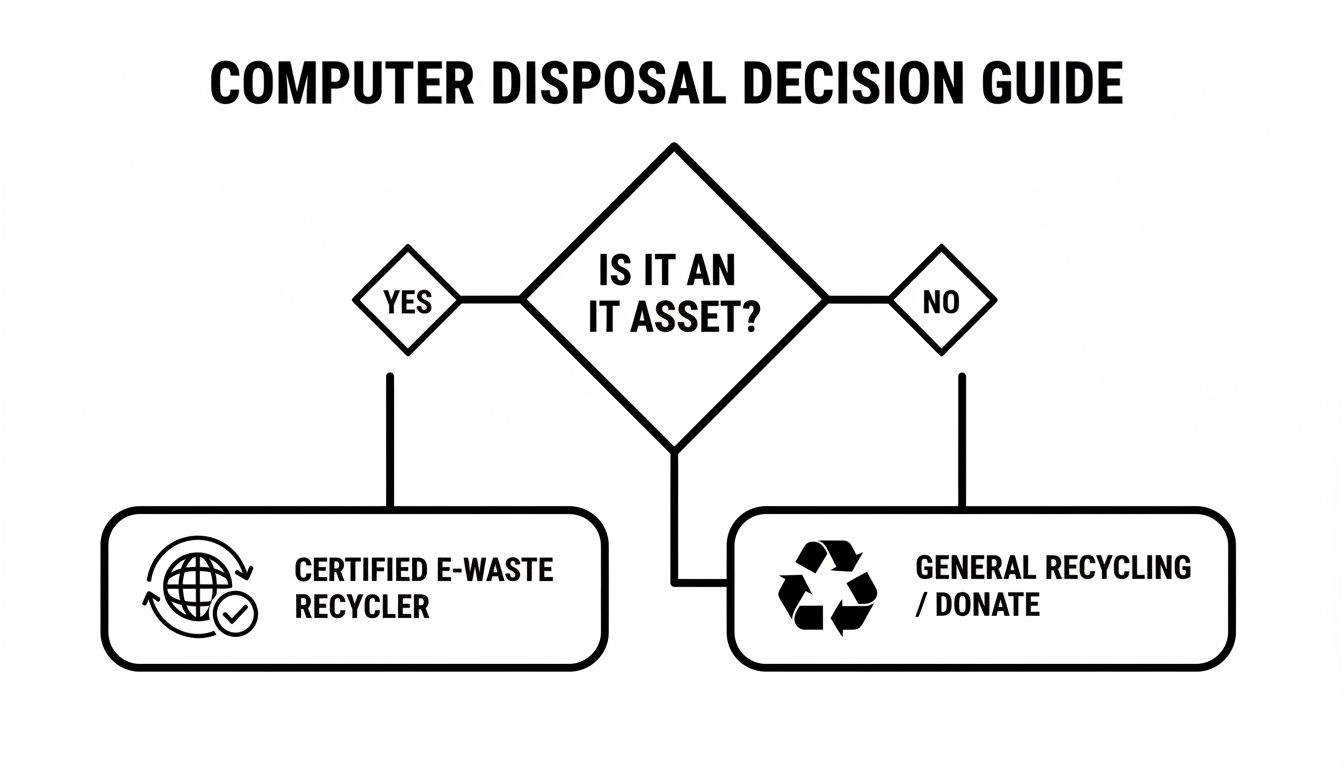
The key takeaway is that corporate IT hardware requires a certified ITAD specialist, not a general recycling service. It’s all about protecting the data.
Choosing The Right Data Destruction Method For Your Business
When it comes to sanitizing your data, your business has two highly effective, certified options. The method you choose typically depends on your internal security policies, compliance requirements, and the sensitivity of the data being protected.
- Data Wiping (Erasure): This software-based method overwrites every sector of a hard drive with random characters, rendering the original data completely irrecoverable. The process adheres to strict standards like NIST 800-88, ensuring it meets rigorous government and industry benchmarks. Wiping is ideal for newer, functional hard drives that may be remarketed, allowing your business to recover value from retired assets.
- Physical Destruction (Shredding): For devices that are obsolete, non-functional, or contain highly sensitive information, physical shredding is the definitive solution. Industrial shredders grind hard drives, SSDs, and other media into small, unsalvageable fragments, guaranteeing permanent data elimination.
Understanding the technical aspects of data sanitization is crucial for IT managers. To learn more, see our detailed guide on how to properly wipe a computer hard drive. It explains the standards and processes that keep your corporate information secure.
The Importance Of A Certificate Of Data Destruction
Regardless of the method used, the process must conclude with official documentation. A Certificate of Data Destruction is the auditable proof your organization requires to demonstrate due diligence.
This legally binding document serves as your official record. It details every serialized asset that was destroyed, confirming the date, the method used, and the chain of custody. It effectively transfers liability from your company to your certified ITAD partner.
For any business in Georgia, this certificate is your defense against potential legal challenges and regulatory audits. It proves you took every necessary step to protect sensitive client, employee, and proprietary information. Any reputable ITAD partner will provide this as a standard component of their service.
How To Choose A Certified ITAD Partner In Georgia
Not all electronics recyclers are created equal—a lesson Georgia businesses cannot afford to learn the hard way when data, reputation, and legal compliance are at stake.
Choosing a partner for your retired computer equipment is not about finding a vendor to haul away assets; it is about vetting a security partner. The right choice actively shields you from risk, while the wrong one can expose your business to catastrophic liabilities.
A true IT Asset Disposition (ITAD) partner operates at a completely different level than a standard scrap yard or general recycler. Their entire process is designed to manage the complexities of corporate assets, from ironclad data security to environmental compliance.
Decoding Industry Certifications
When evaluating a potential ITAD partner, their certifications are the first and most critical credential to verify. These are not merely logos for a website; they represent a firm commitment to rigorous standards verified by independent auditors—standards that directly protect your business.
Key certifications to look for include:
- R2 (Responsible Recycling): This certification indicates the recycler meets high standards for environmental safety, worker health, and data security throughout the entire process.
- e-Stewards: Often considered one of the most stringent standards, e-Stewards provides a guarantee that no hazardous e-waste is exported to developing nations and that maximum data security protocols are enforced.
- NAID AAA: This is the gold standard for data destruction. A NAID AAA certified company has passed extensive, unannounced audits covering everything from hiring practices to security protocols, ensuring your data is permanently destroyed.
Asking a potential vendor if they hold these certifications is a quick and effective way to filter out unqualified providers from the start.
Essential Questions To Ask Your ITAD Vendor
Certifications are the minimum requirement, but you must dig deeper into their operational procedures. A true professional will provide clear, confident answers to these critical questions.
While it is common for Georgia businesses to begin their search with queries like "computer recycling near me," a professional partner should be easily discoverable through such terms, indicating their understanding of the local market and how to rank for 'near me' searches.
You must also inquire about their downstream vendor policies. Where does your equipment go next? This is crucial, as you do not want your liability extending to an uncertified third party.
Finally, always request proof of liability insurance that specifically covers data breaches and environmental incidents. A transparent chain-of-custody protocol is non-negotiable—you need a documented paper trail for every single asset, from the moment it leaves your facility to its final disposition. You can learn more about how our comprehensive ITAD services in Georgia are built around these safeguards.
A certified ITAD specialist assumes the risk and liability for your assets upon taking possession. A standard recycler or scrap yard often leaves that liability squarely on your shoulders, providing no real protection if something goes wrong.
The difference is stark. A specialized partner is the only responsible choice for corporate computer recycling.
Comparing ITAD Partners vs. Standard Recyclers for Georgia Businesses
For the disposal of corporate IT assets, your choice of provider is critical. The distinction between a certified ITAD partner and a general recycler is about security, compliance, and liability. This table highlights the key differences for business audiences.
| Feature | Certified ITAD Partner (e.g., Beyond Surplus) | Standard Recycler or Scrap Yard |
|---|---|---|
| Data Security | NAID AAA Certified data destruction (wiping, shredding). Guaranteed & verifiable. | Often no certified process. Data may be left intact or improperly wiped. |
| Legal Compliance | Deep knowledge of FTC, HIPAA, FACTA. Provides compliance documentation. | Little to no understanding of data privacy laws, leaving you exposed. |
| Chain of Custody | Detailed, serialized reporting for every asset from pickup to final disposition. | Minimal or no tracking. Assets can easily get lost in the shuffle. |
| Liability | Assumes liability for data and environmental risks upon possession. | Liability often remains with your business. No protection from fines. |
| Certifications | Holds key certifications like R2, e-Stewards, and NAID AAA. | Typically uncertified, with no third-party audits or accountability. |
| Value Recovery | Actively seeks to remarket viable assets to return value to your business. | Focuses on scrap material value only. No potential for IT buyback. |
| Environmental Focus | Guarantees responsible, ethical recycling and zero-landfill policies. | May export e-waste illegally or use unsafe disposal methods. |
Partnering with a certified ITAD provider is not an expense—it is an investment in risk management. For any Georgia business, making the right choice is crucial for protecting your data, reputation, and bottom line.
Streamlined IT Asset Pickup And Logistics For Businesses
Your business operations should not grind to a halt to manage retired IT equipment. A professional ITAD partner manages every detail, from inventory to removal, allowing your team to focus on core business functions. Our goal is to make computer recycling in Georgia a seamless, efficient process for your enterprise.

Whether you have a few servers in a closet or a warehouse full of desktops, a top-tier partner handles the entire scope. This is not a basic pickup service; it is a white-glove logistical solution. We provide all necessary labor and materials—pallets, shrink wrap, and packing supplies—to ensure the physical removal of your assets is completely turnkey.
From Inventory To Scheduled Pickup
The process begins with a consultation to understand the scope of your project, including the types and quantities of equipment being retired. This initial inventory allows us to plan the logistics for a flawless pickup.
Here is what the process typically looks like:
- On-Site Inventory and Palletizing: Our technicians can come directly to your facility in Georgia to professionally inventory, sort, and securely palletize all equipment. This ensures the pickup is organized and accurate from the start.
- Flexible Scheduling: We schedule pickups at a time that minimizes disruption to your operations, whether during business hours or after.
- Secure Transportation: Using a dedicated fleet and trusted logistics partners, we ensure your assets are transported securely from your location to our processing facility.
The entire procedure is designed to be turnkey, requiring minimal involvement from your team. For a closer look at how we manage the complete chain of custody, learn more about our IT equipment pickup services in Georgia.
Unlocking Value from Your Retired Corporate Assets
Disposing of old computer equipment does not have to be a business expense; it can be a source of revenue. A key service that differentiates a true ITAD partner is value recovery. We identify and remarket any retired assets with remaining market value, turning a potential cost into a positive return for your budget.
A transparent IT buyback program provides a clear financial return on your retired technology. By assessing the fair market value of viable equipment, your ITAD partner can often offset or even exceed the costs of recycling and data destruction services.
Not every piece of equipment will qualify, but significant value can often be found in your IT storage. Assets that frequently have strong resale potential include:
- Recent-model servers and enterprise networking gear
- Business-grade laptops and desktops less than five years old
- Specialized medical or laboratory testing equipment
A transparent buyback process includes detailed reporting, showing exactly which assets were resold and the value recovered, ensuring you receive a fair return. This transforms computer recycling from a simple disposal task into a strategic financial decision for your Georgia business.
Handling Specialized IT And Electronic Equipment For Commercial Clients
When your Georgia business needs computer recycling services, you may be dealing with more than just standard desktops and laptops. Many industries rely on highly specialized electronic equipment, and disposing of these assets requires a partner with specific expertise. A general e-waste recycler is not equipped to manage the unique security, environmental, and logistical challenges these items present.
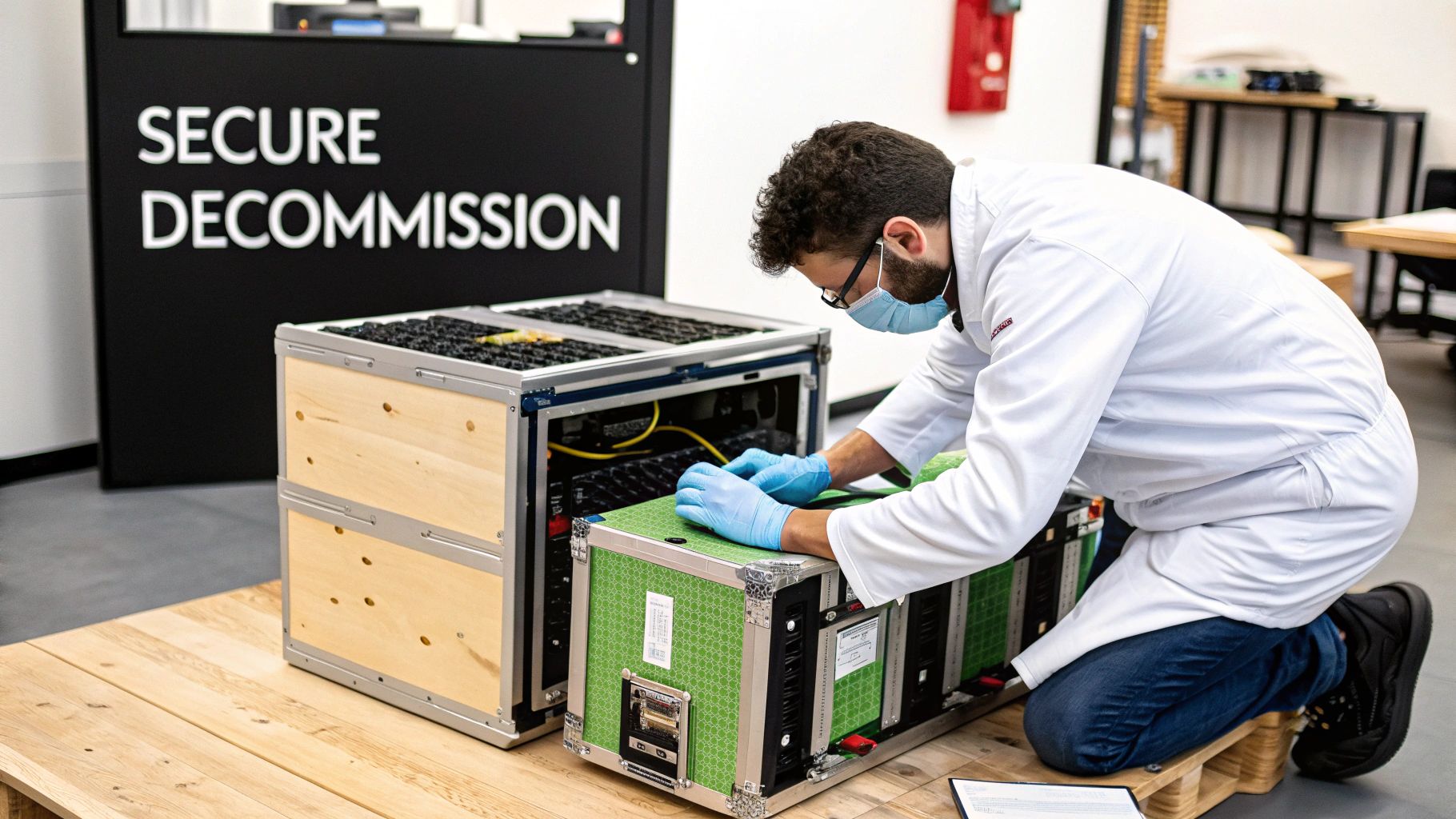
This is particularly true for large-scale projects like data center decommissioning. This is not just about unplugging servers; it is a complex operation involving the careful dismantling, inventorying, and secure transport of server racks, networking gear, and critical power infrastructure.
Data Center Decommissioning And Server Recycling
A full-scale data center decommissioning is a significant undertaking that demands meticulous planning and execution. The process involves de-racking servers, switches, and SANs while maintaining a perfect chain of custody for every data-bearing device. A single error could lead to a major data breach or operational disruption.
A certified ITAD partner manages this entire lifecycle, ensuring every piece of equipment is accounted for and its data is verifiably destroyed according to NIST 800-88 standards. You can get a closer look at our process in our guide to data center equipment recycling in Georgia.
Medical And Laboratory Equipment Disposal
Disposing of medical and laboratory equipment adds another layer of complexity. These devices often contain sensitive Protected Health Information (PHI) and may be contaminated with biohazards.
Proper disposal requires adherence to strict regulations covering both data privacy (like HIPAA) and the handling of potentially hazardous materials. A specialized recycler understands these dual requirements, ensuring devices are not only sanitized of all data but are also decontaminated and processed in a manner that protects public health and the environment.
Key Takeaway: For specialized assets like medical devices or proprietary prototypes, the risk of improper disposal is magnified. The process must guarantee both total data annihilation and compliance with industry-specific environmental and safety regulations.
Secure Product And Prototype Destruction
What is the proper disposal method for pre-production models, proprietary hardware, or recalled products? Leaving them intact creates a significant risk of intellectual property theft. Secure product destruction is the only way to guarantee these items never enter the secondary market.
This service is not recycling; it is the complete physical obliteration of the items, rendering them unusable and unrecognizable. The entire process is documented from start to finish, providing an auditable paper trail that proves your IP has been permanently protected. This is an essential service for any Georgia business involved in manufacturing, R&D, or product development.
The e-waste recycling market is a massive global industry, with North America holding the largest share at approximately 37%. This market, projected to reach USD 17,320.66 million in 2025, is heavily influenced by strict regulations like the Resource Conservation and Recovery Act (RCRA). This regulatory pressure drives the need for advanced recycling infrastructure, making certified partners essential for Georgia businesses managing any type of end-of-life IT assets. You can discover more insights about the global market dynamics on cognitivemarketresearch.com.
Your Georgia Business Computer Recycling Questions Answered
When tasked with disposing of company IT assets, IT managers and business owners in Georgia need clear, direct answers regarding cost, scheduling, and documentation. Here are straightforward answers to help you make an informed decision that protects your business.
Our goal is to provide the information you need to select a partner confidently, ensuring your company is protected from every angle.
What Does Business Computer Recycling Cost?
The cost of business computer recycling in Georgia varies, as each project is unique. There is no flat fee for commercial services.
Several key factors influence the final price:
- The Equipment Itself: The logistics for picking up a few dozen desktops are completely different from decommissioning and removing hundreds of servers from a data center. The type and volume of equipment are primary cost drivers.
- Data Destruction Needs: If you require the highest level of security, such as on-site hard drive shredding, the cost will be higher than off-site data wiping due to the specialized equipment and technicians required at your facility.
- Logistical Details: Your location, building access (e.g., loading dock vs. stairs), and the need for on-site packing and palletizing services all factor into the logistical costs.
- Potential for Value Recovery: If your retired equipment has resale value, an IT buyback program can significantly reduce or even eliminate your net costs for electronics recycling and IT asset disposal.
A reputable ITAD partner will always provide a transparent, itemized quote after assessing your inventory and service requirements, ensuring no surprise fees.
How Do I Schedule A Pickup For My Company's Old Computers?
Scheduling an IT asset pickup should be a smooth process that does not disrupt your business operations. It typically begins with a brief consultation to outline the retired IT assets you need removed.
From there, a certified partner will:
- Review Your Inventory: We will assess the project scope based on the equipment list you provide.
- Provide a Quote: You will receive a clear proposal detailing all services, costs, and potential returns from value recovery.
- Handle the Logistics: Once approved, we will coordinate with your team to schedule a pickup time that suits your business. Our professional crews manage all heavy lifting, packing, and secure transport.
What Kind Of Documentation Should I Expect?
Proper documentation is the cornerstone of responsible IT asset disposal and is non-negotiable. It serves as your official proof of compliance and the legal record that transfers liability from your company to your recycling partner.
You should always receive a Certificate of Data Destruction and a Certificate of Recycling. These documents provide a complete, auditable trail detailing every serialized asset, confirming your data was destroyed and the hardware was managed in accordance with all environmental laws.
This paperwork is your defense against potential fines and legal challenges, proving you followed all necessary protocols to protect sensitive information and dispose of e-waste responsibly.
The need for this level of detail is more critical than ever. Globally, e-waste generation exploded to 62 million metric tons from 2010 to 2022. However, documented recycling efforts have not kept pace, leaving a staggering 78% of that e-waste unaccounted for. For businesses in Georgia, that statistic highlights the vital importance of working with a certified partner to ensure your equipment is handled correctly. You can dig into more of these e-waste trends on Statista.
For a partner that delivers certified, secure, and completely transparent computer recycling services across Georgia, you can count on Beyond Surplus. We create ITAD solutions that protect your data, guarantee compliance, and maximize the value recovered for your business. Contact us today to schedule a consultation and receive a transparent quote for your IT asset disposal needs.