A typical office cleanout starts the same way. Retired laptops stack up after a refresh, old network gear gets pushed into a storage room, and someone asks IT or procurement to “find a recycling center near me” before the pile becomes a problem.
For a business, that search usually points to consumer drop-off locations. Those locations may work for a single printer or a few dead peripherals. They rarely solve the harder parts of commercial e-waste, such as documented chain of custody, certified data destruction, site pickups, de-installation, and scheduling around business operations.
This distinction is critical for businesses. The right provider is not the closest one. The better question is whether the recycler can account for every data-bearing asset, issue the paperwork your security or compliance team will ask for, and handle volume without creating more work for internal staff. If you are sorting resale, reuse, and scrap value, it also helps to know understanding the critical differences between refurbished and used electronics before assets leave your control.
That is the filter used here. This list is built for business and IT managers, not household drop-offs. It looks at national and local options through an enterprise lens, including security controls, destruction records, logistics, and suitability for bulk disposals. If you need a baseline on process before choosing a vendor, this step-by-step guide on how to recycle electronics is a practical place to start.
Some of the providers below operate as full ITAD partners. Others are useful for limited categories or small-volume overflow. The deciding factor is documentation and operational fit, because once equipment leaves your site, undocumented handling creates security exposure, audit friction, and unnecessary risk.
1. Beyond Surplus
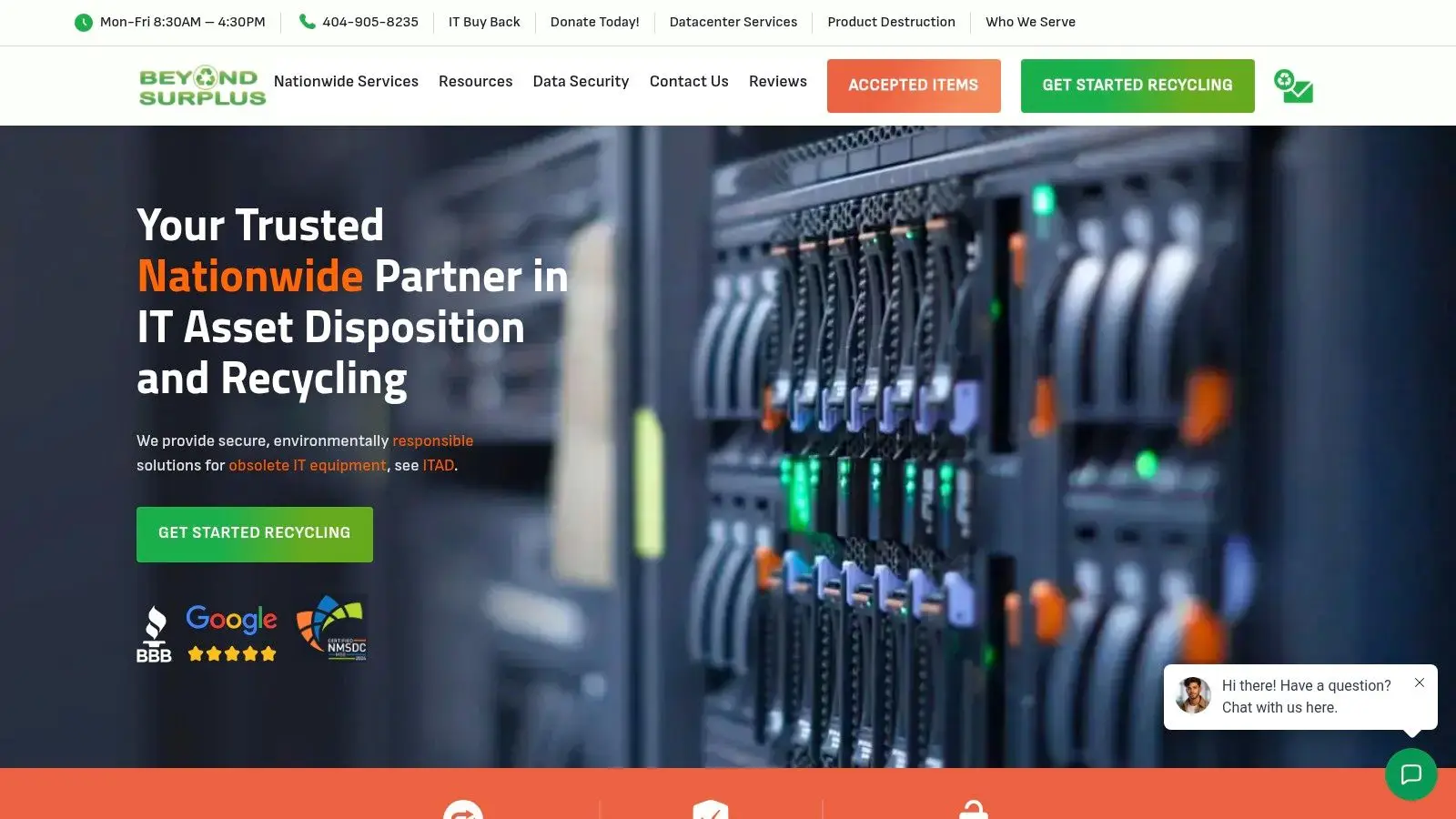
Beyond Surplus is the strongest fit here for businesses that need more than a nearby drop-off counter. It is an Atlanta-headquartered ITAD and electronics recycling company built around commercial pickups, secure processing, data destruction, and downstream documentation.
What stands out is the mix of practical logistics and compliance discipline. Beyond Surplus handles pickups across the contiguous United States for business clients, coordinates loading and transportation, and supports de-installation, data center work, product destruction, recycling, and IT buyback. That matters when you are dealing with multiple offices, an equipment room cleanout, or a larger refresh where internal staff should not be spending days staging retired gear.
Where it works best
For regulated organizations, the differentiator is documentation. Beyond Surplus provides certified data wiping and hard drive shredding options, then issues certificates of data destruction and recycling. If your legal, compliance, or security team asks for proof, you have an audit trail instead of a verbal promise.
The service is especially practical for healthcare, finance, government, education, and data center environments where retired assets often contain regulated or sensitive data.
If hard drives, SSDs, or backup media are involved, do not choose a vendor based only on distance. Choose based on whether they can prove custody, destruction, and final disposition.
A second advantage is value recovery. Public recycling centers usually treat everything as waste. A proper ITAD partner sorts for reuse, remarketing, parts harvest, and recycling. That is the difference between paying only to remove equipment and offsetting part of the project through resale of usable hardware.
Beyond Surplus also has a local Atlanta-area facility in Smyrna, which is useful when a nearby “center recycling near me” search needs to turn into a real commercial solution instead of a generic directory listing. Businesses trying to sort through disposal paths should start with this guide on how to recycle electronics.
Trade-offs
The main downside is that pricing is inventory-dependent. That is normal in ITAD, but it means you may need a quote for copiers, bulk pickups, or mixed loads. This is not a fixed-price retail model.
Pros and cons in plain terms:
- Best for security: On-site shredding and certified wiping support defensible disposal workflows.
- Best for logistics: Pickup, pallet handling, and transportation reduce project management on your side.
- Best for recovery: Buyback can help recover value from newer laptops, servers, and networking gear.
- Less ideal for price shoppers: Some items or pickups may carry charges depending on mix and scope.
Businesses comparing reuse versus scrap value should also understand the critical differences between refurbished and used electronics.
Website: Beyond Surplus
2. Live Thrive CHaRM

A common Atlanta scenario looks like this. The office has a closet full of old keyboards, a few monitors, loose cables, maybe a printer or two, and someone searches “center recycling near me” because the volume is too small for a full pickup project. Live Thrive CHaRM fits that job well.
CHaRM is a local, appointment-based drop-off option for businesses that can box material internally and deliver it on their own schedule. For small office cleanouts, that structure is useful because accepted items, intake rules, and fees are posted clearly on the organization’s site. You can usually tell before the trip whether the load belongs there.
The commercial trade-off is control. CHaRM helps with local diversion of hard-to-recycle items, but business and IT managers still need to separate simple recycling from defensible IT asset disposition. If the load includes laptops, desktops, drives, or anything else with stored data, the standard should be chain of custody, asset tracking, and documented destruction outcomes. That is the key screening point in this guide to what to look for in recycling center options.
Best use case
CHaRM works for limited volumes, non-urgent timelines, and companies that do not need de-installation, serialized reporting, or palletized logistics. A branch office cleanup or facilities-driven electronics purge is a reasonable fit.
For audit-sensitive work, I would ask harder questions before sending anything out the door. Who signs for intake. What paperwork comes back. Whether data-bearing devices are handled under a documented process. Those answers matter more than proximity.
Practical trade-offs
CHaRM is a solid local outlet for miscellaneous electronics, especially when your team can transport items without outside help. It is less suited to larger refresh projects where security documentation and operational scale drive the decision.
- Good fit: Small office drop-offs, miscellaneous electronics, clear appointment process
- Watch for: Self-transport, item fees, limited suitability for bulk IT assets or compliance-driven disposition
Website: Live Thrive CHaRM
3. Best Buy Electronics & Appliance Recycling
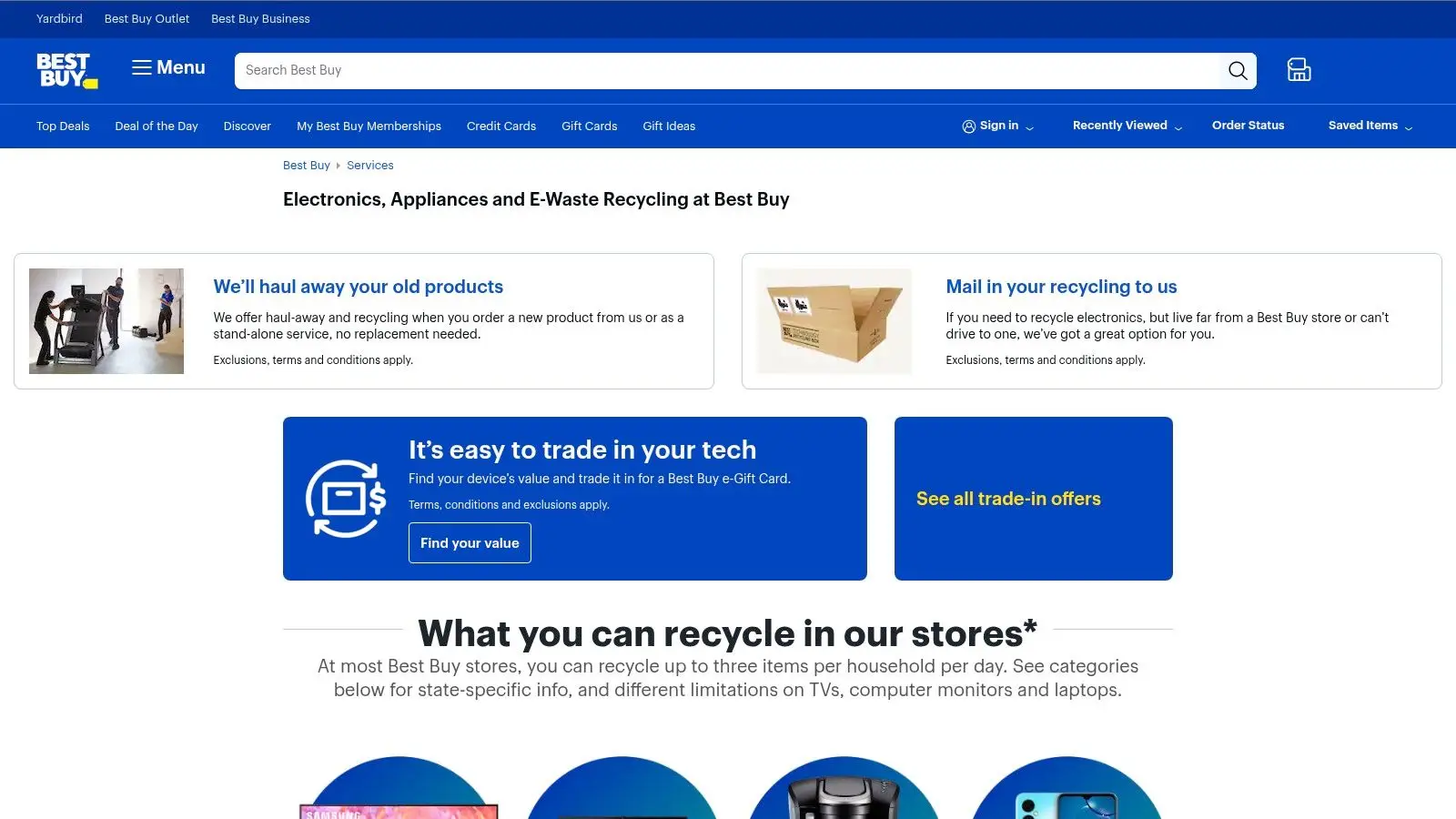
A branch manager finds three retired laptops, two broken monitors, and a box of cables during an office cleanup. The team wants them gone this week, without setting up a pickup or waiting on a project quote. That is the lane where Best Buy usually fits.
For business and IT managers, the value is simple. National store coverage, familiar intake, and a low-friction option for small quantities of general electronics. If the goal is to clear out accessories or a few low-risk devices from a branch office, retail recycling can be a practical outlet.
The trade-off is documentation. Best Buy operates a consumer-facing recycling program, while ITAD providers are built to give businesses auditable control, including asset tracking, data destruction records, and chain-of-custody support. If your load includes anything with stored data, review your requirements before defaulting to a store drop-off. This guide on how to recycle a computer securely for business use is a better starting point for that decision.
Best use case
Best Buy works best for low-volume, non-project material. Examples include keyboards, mice, cables, small accessories, and occasional office electronics that do not justify scheduling an enterprise pickup.
It becomes less suitable once the disposal has compliance implications. Laptops, desktops, drives, phones, and network gear usually require a documented process, especially if your company has internal security policies, client obligations, or regulated data concerns.
Practical trade-offs
Use Best Buy when convenience matters more than reporting depth. Do not treat it as a substitute for a business ITAD workflow.
- Good fit: Small office cleanouts, branch-level peripheral recycling, quick retail drop-off
- Watch for: Limited business documentation, no project logistics, weak fit for data-bearing assets
- Escalate to ITAD if: You need serialized inventories, certificates of destruction, pickup, or downstream accountability
Website: Best Buy recycling
4. Staples Free Tech Recycling
Staples sits in a slightly different lane from Best Buy. It is particularly handy for small business odds and ends. Think keyboards, cords, mice, toner-related tech clutter, low-volume office electronics, and the random drawer of adapters everyone ignores until move-out week.
Its broad in-store acceptance is useful for branch offices and admin-led cleanup.
Where Staples helps
If your company has many small locations, Staples can be a workable outlet for peripheral waste that would be inefficient to include in a dedicated ITAD project. It is also one of the easier retail paths for routine office tech turnover.
For a small office asking where to recycle a few old desktops or accessories, this article on how to recycle a computer is a better starting point than relying on a store trip alone.
The limitation is obvious. Staples does not give you the reporting depth, destruction verification, or project handling that larger business disposals require. It is a retail intake network with some useful convenience features, not a compliance-forward service model.
A good benchmark here comes from material recovery markets more broadly. Northeast MRF reports show commodity volatility, with average value falling 8.96% to $68.41 per ton excluding residuals, while dual-stream systems maintained higher pricing due to cleaner sorted outputs (Northeast Recycling Council quarterly MRF reports). In practice, that is why serious ITAD vendors separate reusable hardware from scrap carefully. Retail collection rarely gives your business much visibility into that process.
Practical verdict
Staples is solid for small, messy, low-risk tech clutter. It is weak for anything that needs asset-level accountability.
- Use it for: Peripherals, accessories, branch office cleanouts
- Do not use it for: Data center gear, regulated devices, or anything requiring certificates
Website: Staples recycling
5. The Battery Network
A branch office cleanout often looks simple until the batteries show up. Dead laptop packs, cordless tool batteries, UPS units, and swollen lithium-ion cells change the handling plan fast because storage, packaging, and transport rules are different from standard IT gear.
That is why The Battery Network earns a spot on a business-focused list. It solves a narrow problem well. If your team needs a local path for battery waste, especially from mobile device fleets or facilities closets, its drop-off network can be useful.
The trade-off is scope. The Battery Network helps with battery collection and location finding. It does not replace an ITAD partner that can pick up mixed loads, track assets, document chain of custody, and issue destruction records for devices and drives. For any project that includes storage media, review the requirements for secure hard drive destruction documentation and process controls before treating battery recycling as the whole job.
Beyond Surplus also publishes practical guidance on battery recycling drop-off locations for teams sorting local battery disposal options.
Best fit for business use
Use this option when the battery stream is the project. It works well for satellite offices, maintenance departments, and IT teams clearing loose battery inventory that general electronics programs may reject or accept only with restrictions.
It is a weak fit for office decommissions. If pallets include laptops, monitors, network gear, or loose drives, a battery-only network leaves the harder compliance and logistics work unresolved.
- Best for: Battery-only disposal, satellite office cleanup, safe local handoff
- Worst for: Mixed IT loads, servers, computers, drives, or complete office decommissions
Website: The Battery Network
6. ERI
A common scenario in business IT looks like this. One office has a few retired laptops. Another has palletized monitors and networking gear. Legal wants documented data destruction, procurement wants certifications on file, and facilities wants one vendor that can cover multiple sites. ERI fits that kind of assignment.
ERI is a national enterprise electronics recycler and ITAD provider with the process controls larger organizations often require. Compared with a more local, service-heavy partner like Beyond Surplus, ERI usually appeals to teams that need formal vendor onboarding, broader geographic coverage, and standardized workflows across locations.
Why ERI belongs in the enterprise tier
ERI offers secure data destruction, business pickup and logistics programs, and mail-back options for smaller asset volumes. For IT managers, the central question is not whether a recycler accepts equipment. The question is whether the provider can document custody, destroy data in a verifiable way, and scale from one site to many without the process breaking down.
That is the right standard for storage media in particular. Use this checklist for verifiable hard drive destruction methods and documentation before approving any vendor.
The trade-off is administrative weight. Enterprise ITAD vendors tend to use quote-driven workflows, scheduled pickups, and tighter intake requirements. That structure helps with audit readiness and internal compliance reviews, but it can feel slow if the job is a single closet cleanout or a small batch of end-user devices.
My practical take
ERI is a strong fit for regulated businesses, multi-site companies, and procurement-led organizations that want a large vendor file behind the service. It is a weaker fit for teams that need fast local turnaround, flexible pickups, or hands-on help sorting a mixed small-volume load.
Website: ERI
7. Sims Lifecycle Services
A company closes a server room, has assets in three offices, and needs drives destroyed, racks removed, and audit records preserved. That is the kind of job Sims Lifecycle Services is built to handle.
Sims fits large ITAD projects with moving parts, especially data center exits, infrastructure refreshes, and multi-site equipment retirement. Business and IT managers should read this as a specialized service, not a general recycling stop. The value is in controlled logistics, documented custody, and programs that can handle enterprise hardware at volume.
Best fit for large environments
Sims stands out when the scope goes beyond pallets of laptops. It handles de-installation, asset recovery, and disposition programs for organizations that need a managed process from shutdown through final reporting. That matters for environments with racks, storage arrays, network gear, and large batches of media that require tracked destruction.
For commercial teams, the key question is operational control. Local recycling options can be fine for small loads, but they often do not offer the level of project coordination, chain-of-custody records, and downstream documentation that procurement, compliance, and security teams expect for major retirements. Sims is built around that higher bar.
Trade-offs to expect
The process is heavier than a local pickup. Expect scoping calls, scheduling windows, site coordination, and formal statements of work.
That structure is appropriate for decommissioning projects. It is usually too much for a basic office cleanout or a small batch of retired desktops.
My practical take is simple. If the job includes shutdown sequencing, rack removals, logistics across facilities, or value recovery on enterprise equipment, Sims belongs on the shortlist. If the goal is fast disposal of a limited number of devices, a regional ITAD vendor or local business recycler will often be easier to work with.
Website: Sims Lifecycle Services
7-Way Comparison of Local Recycling Centers
| Service | Implementation Complexity 🔄 | Resource Requirements ⚡ | Effectiveness & Compliance ⭐ | Expected Outcomes / Impact 📊 | Ideal Use Cases & Tips 💡 |
|---|---|---|---|---|---|
| Beyond Surplus | Medium–High, on-site shredding, logistics coordination 🔄 | Moderate, palletized pickups, business-scale handling ⚡ | High, certified wiping/shredding, chain-of-custody ⭐⭐⭐ | Secure disposition, value recovery, auditable certificates 📊 | Enterprise/local Atlanta businesses; compliance-heavy sectors; request itemized quote 💡 |
| Live Thrive CHaRM | Low, appointment drop-off model 🔄 | Low, drive-to-site drop-off, scheduled appointments ⚡ | Moderate, nonprofit program, transparent pricing but no enterprise certificates ⭐⭐ | Local diversion, low-cost resident disposal, community education 📊 | Atlanta/DeKalb residents; check appointment slots and published fees 💡 |
| Best Buy Recycling | Low, retail drop-off or scheduled haul-away 🔄 | Low–Medium, store limits, possible haul-away fees ⚡ | Low–Moderate, convenient but not for chain-of-custody needs ⭐⭐ | Easy consumer recycling, paid haul-away for bulky items, wide coverage 📊 | Consumers/small offices; verify store limits and TV/monitor fees before drop-off 💡 |
| Staples Free Tech Recycling | Low, in-store drop-off, rewards program 🔄 | Low, retail footprint; monitor fees may apply; rewards enrollment ⚡ | Low–Moderate, broad acceptance, no formal destruction certificates ⭐⭐ | Incentivized recycling for peripherals and batteries, convenient retail access 📊 | Frequent recyclers and small offices; use Easy Rewards for points, confirm monitor fees 💡 |
| The Battery Network | Low, public drop-off bins and retail partners 🔄 | Low, battery-specific handling and site variation ⚡ | High for batteries, stewardship program with compliant handling ⭐⭐⭐ | Safe battery collection, reduced hazard risk, e-bike battery options 📊 | Anyone with rechargeable/supported single-use batteries; use online locator and check site rules 💡 |
| ERI (Electronic Recyclers International) | High, enterprise logistics, certified facility processes 🔄 | High, project coordination, nationwide pickups or mail-back kits ⚡ | Very High, R2v3, e-Stewards, NAID AAA, SOC 2 Type II ⭐⭐⭐⭐ | Auditable chain-of-custody, asset remarketing, compliance-ready reporting 📊 | Regulated industries and enterprises needing certified ITAD; expect quotes and lead times 💡 |
| Sims Lifecycle Services (SLS) | High, global decommissioning and complex workflows 🔄 | Very High, multi-site contracts, large-scale logistics ⚡ | Very High, facility certifications and global process controls ⭐⭐⭐⭐ | Large-scale asset recovery, circularity programs, bulk drive destruction 📊 | Hyperscale/data-centers and multi-site enterprises; contract-based SLAs and custom scopes 💡 |
Choosing Your Partner for Secure IT Asset Disposition
Most businesses start with the wrong question. They ask, “What center recycling near me can take these items?” The better question is, “Which provider can protect data, document the process, and remove this equipment without creating more work for your team?”
That distinction separates local convenience from IT asset disposition.
Retail and nonprofit drop-off options have a place. Best Buy and Staples can help with light office clutter. CHaRM is useful for Atlanta-area drop-off situations. The Battery Network solves a battery-specific problem that many recyclers only partially cover. Those are all workable in the right context.
But once you move into laptops with stored credentials, retired desktops from multiple offices, medical or lab devices, backup media, or data center hardware, the standard local-center model starts to break down. You need custody records, verified destruction, downstream transparency, and someone who can handle logistics without tying up your internal staff.
That is why enterprise-focused ITAD providers rise to the top. ERI and Sims Lifecycle Services are credible large-scale options for organizations that want broad national or multi-site support. They are especially relevant when procurement teams want established enterprise programs and formal process controls.
For many organizations, though, Beyond Surplus is the most practical balance of security, responsiveness, and service depth. The company covers the parts that matter most in the field: pickup coordination, de-installation, data wiping, hard drive shredding, certificates of destruction and recycling, value recovery, and support for regulated industries. It is built for commercial work, not just material intake.
This matters even more when businesses are also managing broader infrastructure projects. Teams already dealing with relocation, buildout, or refresh planning often run into the same operational friction described in these challenges in data center construction. Disposal becomes another moving part unless the vendor can own it end to end.
The short version is simple. If you only need a nearby drop-off for a few low-risk accessories, use a convenient local option. If you need security, compliance, and a clean audit trail, hire an ITAD partner that treats retired equipment like a controlled asset stream.
For businesses that want a secure and auditable answer, Beyond Surplus is the clear first call.
Contact Beyond Surplus for certified electronics recycling, secure data destruction, IT asset recovery, and business pickup services that meet your organization’s inventory, compliance requirements, and timeline.